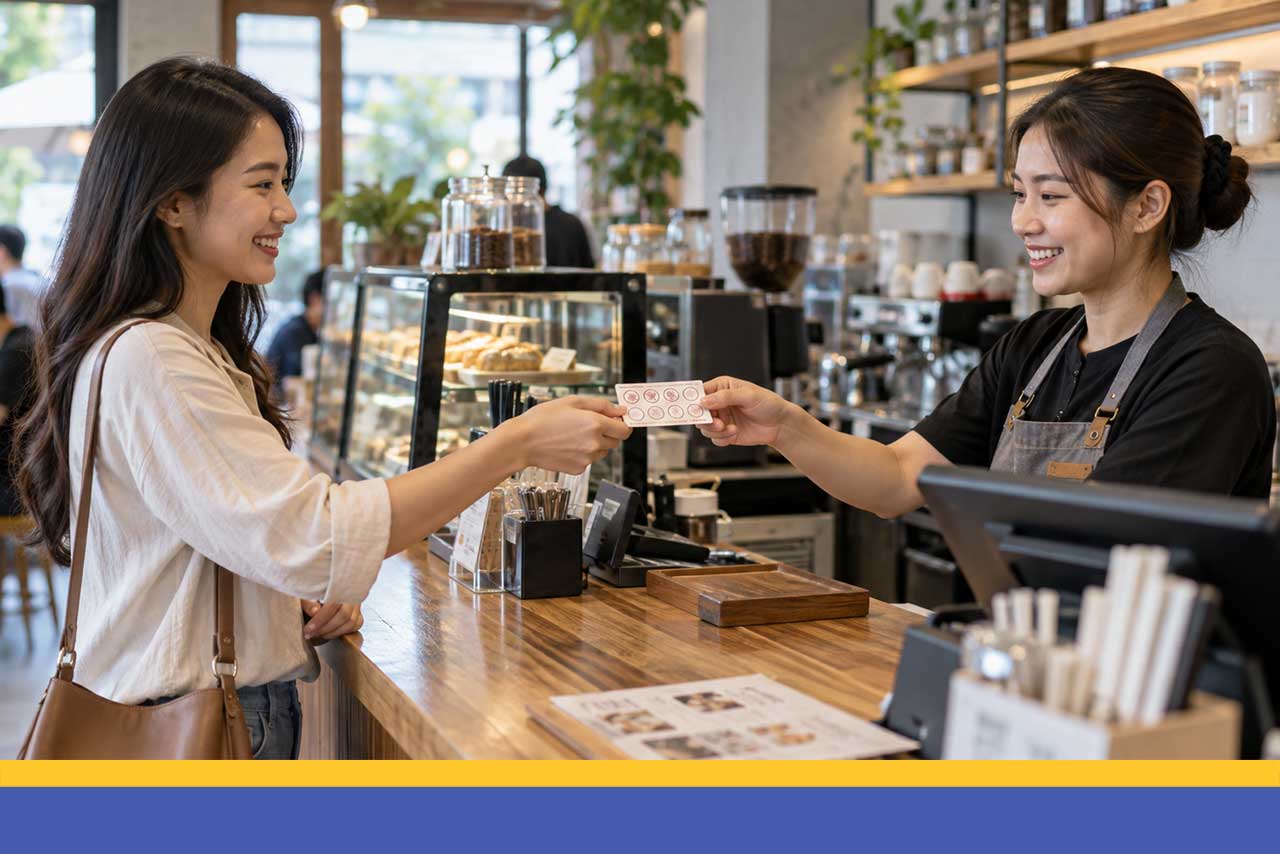
You have probably run a loyalty programme already. Cards were printed, stamps were given out, a few were redeemed, and then it quietly stopped being something anyone mentioned. If someone asked whether it changed customer behaviour, you would have to say you are not sure.
That is the normal outcome, and it is almost never because the reward was wrong. Merchants spend their thinking on what the customer gets, because that feels like the part that persuades people. Then the programme fails somewhere else entirely, at the ten seconds when someone is meant to join it.
A generous programme that eight per cent of your customers join is worth less than a modest one that most of them join without noticing. Enrolment is the whole game, and it is decided by how much you ask of a person at a counter, not by what you offer them.
Below is a straight comparison of the three ways loyalty is usually run, what actually differs between them, and how to tell which one fits your business.
The Reward Is Not What Decides Whether a Loyalty Programme Works. The Sign-Up Is.
Every loyalty programme has two halves. The offer, which is what you design, and the enrolment, which is what you inherit from whatever system you chose. Almost all the attention goes to the first and almost all the failure happens in the second.
Think about the moment itself. A customer has finished paying and is already half turned to leave. Any request at that point competes with their intention to go. A form takes forty seconds. An app takes a minute and requires them to trust an install. A stamp card is quick but hands them an object to keep track of for the next three months. Each of those is a small tax, and small taxes at the wrong moment are what turn a good idea into a drawer full of unused cards.
What Enrolment Looks Like When It Costs Nothing
A customer buys at nine. You ring it up on QashierPOS and she taps her card. QashierPay takes the payment, and Qashier Treats enrols her through that payment, because the card is her loyalty identity.
She was asked for nothing. No app, no form, no card to keep. She now has points and a profile, and she leaves at the same speed she would have anyway.
Nine days later she has not been back, and Qashier Automated Marketing reaches her about the balance she did not know she had. She returns, taps the same card, and the visit attaches to the same record.
By the end of the month your database has grown by every customer who paid, and your staff had one fewer thing to remember on a busy Saturday. None of that required a single manual action from you.
Side by Side
What you are comparing | Stamp card | Loyalty app | Payment-linked loyalty |
|---|---|---|---|
How a customer joins | Takes a card and keeps it | Downloads an app and registers | Pays as normal |
Time added at your counter | Seconds, plus the stamping | A minute or more | None |
What your staff must do | Offer, find, stamp, hand over | Explain and persuade | Nothing |
What it knows about the customer | A number of stamps | A name and a points balance | A full purchase history |
When you are busy | Usually skipped | Almost always skipped | Unaffected |
What the customer carries | A card that gets lost | An app that gets deleted | Nothing new |
Can you see who is lapsing | No | Only if they used it | Yes, from last visit date |
Can you measure whether it works | No | Partly | Yes, against your sales |
Can you message the right people | No | Broadly, by push | Yes, by actual behaviour |
Who owns the customer data | Nobody, it is on paper | Depends on the platform | Your business |
The First Difference: What the Sign-Up Costs You at the Counter
Every second added to a transaction is paid for twice. Once by the customer being asked, and once by everyone standing behind them.
A stamp card costs a few seconds each visit, forever, because the stamping never stops being a task. An app costs a minute the first time and needs a persuasive staff member to get there. Payment-linked enrolment costs nothing at all, because the action that enrols the customer is the action they came to perform.
That difference sounds small on one transaction and is not small across a lunchtime. It is also the reason the next difference exists.
The Second Difference: What Happens When You Are Busy
This is the part almost nobody accounts for, and it is the most damaging.
Any programme that depends on a staff member asking a question will be abandoned during a rush. Not through laziness, but because a queue is forming and the ask is the easiest thing to drop. So your programme collects customers from your quiet mornings and misses most of the people who came during your best hours.
That does not just reduce your numbers. It skews them. Your customer database ends up describing your slow periods, and any conclusion you draw from it about who your customers are is drawn from an unrepresentative sample. A programme with no ask has no bias, because enrolment does not depend on anyone having time.
The Third Difference: What the Programme Actually Knows
A stamp card knows how many stamps are on it. That is genuinely all. It cannot tell you who the person is, what they bought, when they last came in or whether they have stopped coming.
An app usually knows a name, a contact detail and a balance. Better, but still identity without behaviour, which means it can reach people and cannot tell you which people are worth reaching.
Because Qashier Treats is enrolled through the transaction, every profile carries the purchase history automatically: what they bought, how often, how much and how recently. That is the difference between a list of members and a customer database, and it is what makes the fourth difference possible.
The Fourth Difference: Whether You Can Prove It Works
Most loyalty programmes cannot be measured, which is why so many of them are quietly discounting people who were already coming.
To know whether yours is working, you need to compare member behaviour against non-member behaviour on visit frequency and average basket. That comparison is impossible when the programme lives in one system and your sales live in another, so nobody ever builds it and the programme runs indefinitely on hope.
When loyalty and point-of-sale are the same system, those figures sit in the same report. You can see whether members return more often, whether they spend more, and which of your campaigns actually changed anything. A programme you can measure is one you can improve.
The Fifth Difference: Whether You Can Reach the Right People
Knowing your customers is only useful if you can act on it. The three approaches differ sharply here.
A stamp card gives you no way to contact anyone. An app can push a message to everybody, which is a blunt instrument that mostly reaches people who were coming anyway and irritates the rest. A profile with purchase history lets Qashier Automated Marketing trigger on what someone actually did: a welcome after a first visit, a nudge when a regular goes quiet, a perk for the people who spend most with you.
The message costs the same to send in all three cases. What differs is whether it lands on the right person at the right moment, and that is decided entirely by what the programme recorded at the counter.
The Cases People Make for Stamp Cards and Apps, and Whether They Hold Up
Both alternatives have arguments worth answering rather than dismissing.
Stamp Cards Are Cheap to Start, and Expensive to Keep
Printing cards costs very little, and that is the entire strength of the approach. Everything after printing is a cost: the seconds at the counter, the cards nobody carries, the disputes about a missing stamp, and the fact that at the end of a year you have no idea who any of those customers were. It is the cheapest programme to launch and one of the most expensive to have run.
Apps Can Do More, if Anyone Installs Them
A branded app genuinely can do more. Ordering, wallets, notifications, a presence on the customer's home screen. The problem is the condition attached to all of it. Every one of those benefits requires the customer to download something for a business they may have visited once, and most people will not. A capability that reaches a small fraction of your customers is worth less than a plainer one that reaches nearly all of them.
Where Payment-Linked Loyalty Genuinely Does Not Apply
If a large share of your customers pay in cash, enrolment through the payment reaches fewer of them, and that is a real limit worth naming. It is worth checking your own payment mix before assuming. In most Singapore businesses the cash share is now small enough that this is a minor consideration rather than a deciding one.
How to Choose in Two Minutes
Ask three questions.
First, would your staff reliably offer this during your busiest hour. If the honest answer is no, you are choosing a programme that will collect an unrepresentative slice of your customers.
Second, could you produce a list tomorrow of customers who have not returned in sixty days. If not, your programme is a discount scheme rather than a customer database.
Third, could you tell whether members spend more than non-members. If not, you cannot improve the programme and you cannot justify it either.
Three nos means the programme you are running is costing you more than it returns.
Everything Connects, Which Is the Whole Point
The reason payment-linked loyalty behaves differently is not that it is a better loyalty product. It is that it is not a separate product at all.
The payment enrols the member, so nothing is asked. The sale attaches to the profile, so history builds itself. The history tells the marketing who to reach and when. The return visit deepens the record, so the next message is better than the last. And because all of it sits with your sales, you can see whether any of it is working. Five things that a standalone loyalty tool has to be integrated into, and none of them require integration when the sale and the customer were one record from the beginning.
One login. One view. One platform.
Getting Started
Qashier Treats, QashierPOS, QashierPay, QashierHQ, Automated Marketing and Customer Reviews are all available to Singapore merchants now, on one login. Your customer database starts building from your first transaction, with nothing asked at the counter.
Book a free demo and start building a customer list that fills itself.
Frequently Asked Questions
What is payment-linked loyalty?
Payment-linked loyalty uses the card a customer pays with as their loyalty identity, so they are enrolled during a transaction that was going to happen anyway. There is no app to download, no form at the counter and no card to carry. Because enrolment carries no friction, it reaches far more customers than approaches that require a sign-up step.
Why do stamp cards and loyalty apps stop working?
Both depend on something happening at the counter: a card being offered and stamped, or an app being explained and installed. During a rush that step is the first thing dropped, so the programme captures customers from quiet periods and misses most of your busiest hours. The result is low enrolment and a customer list that does not represent your actual business.
Which type of loyalty programme gets the highest enrolment?
The one that asks least of the customer. Enrolment falls with every second and every decision added at the counter, which is why programmes requiring an app download consistently reach the smallest share of customers. Payment-linked enrolment asks for nothing, so it captures customers regardless of how busy you are.
How do I know if my loyalty programme is working?
Compare members against non-members on visit frequency and average basket size. That comparison is close to impossible when your loyalty programme and your sales sit in separate systems, which is why so many programmes run for years without evidence. On one platform both figures appear in the same report.
Do customers need to download an app to join Qashier Treats?
No. Qashier runs in a web browser and enrolment happens through the payment at checkout, so your customers install nothing and carry nothing. There is no card to lose and no account for them to set up.
What payment methods does QashierPay accept in Singapore?
QashierPay accepts Visa, Mastercard and AMEX, plus PayNow, GrabPay, ShopeePay, Atome and Alipay+ along with other international e-wallets. Settlement is T+1, so your takings arrive the next business day. Every method is recorded on the same platform as the sale.
What happens if most of my customers pay in cash?
Enrolment through the payment reaches fewer of them, so it is worth checking your own payment mix before deciding. In most Singapore businesses the cash share is now small enough that this is a minor consideration, but it is a fair question to ask of your own numbers rather than assume.
Who owns the customer data in a loyalty programme?
It depends entirely on the provider, and it is worth asking before you build anything on top of it. With Qashier Treats the database belongs to your business, builds from your own transactions and can be exported. Ask any loyalty platform what happens to your customer records if you stop using them.
Qashier is the all-in-one platform for merchants in Singapore and Southeast Asia: POS, payments, ordering, bookings, loyalty, marketing and more, all included at $5/day. Tell us what you run, and we'll build the rest.