
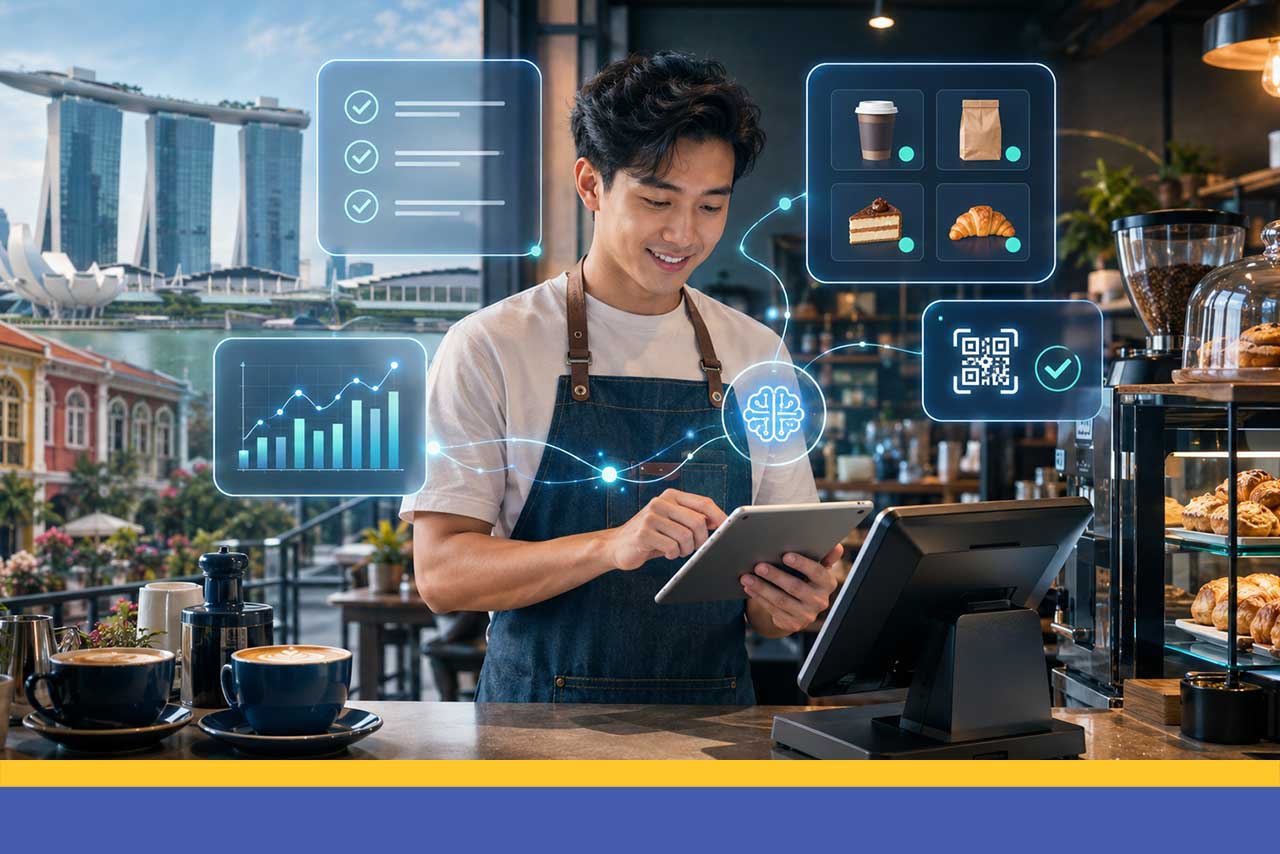
Quick answer: An AI POS system removes the two biggest software headaches for Singapore merchants: setup and follow-up. On platforms like Qashier, you describe your business in one sentence ("I run a bubble tea shop with two outlets") and the system builds your menu, ordering, bookings and loyalty automatically. Once running, AI recognises each customer across every sales channel and sends the right message at the right moment, without staff lifting a finger.
Ask any business owner in Singapore what stopped them digitalising sooner, and you will rarely hear "cost" first. You will hear "time." Weeks of menu uploads, settings screens and configuration calls, squeezed between actual service hours. For a two-person operation, that setup project might as well be a second job.
That barrier is now disappearing, and it is worth understanding what replaced it.
Setup, reduced to a sentence
The newest generation of merchant platforms starts with a prompt, not a settings page. On Qashier, you type what you run:
"I run a bubble tea shop with two outlets."
From that one line, the platform builds the rest: a product catalogue structured for your business type, QR and online ordering, a booking flow if your business takes appointments, a loyalty programme, and a website, all pre-connected because they are all one system.
You then refine rather than configure. Adjust prices, swap photos, tweak your rewards. The difference sounds subtle, but it is the difference between "weeks before first sale" and "trading this week." For Singapore's newest hawkers, cafe owners and salon founders, that is often the difference between digitalising and not.
After setup: AI as your extra staff member
Setup is a one-time win. The bigger, everyday change is what AI does once you are running.
It recognises your customer everywhere. A regular might order at the counter today, through GrabFood tomorrow, and via your website next week. Traditionally those are three strangers in three databases. On one platform, identity resolution connects them into a single profile: one loyalty balance, one order history, one picture of who this customer actually is, across up to nine channels including foodpanda, Shopify, WooCommerce and Shopee.
It acts on its own. When that customer crosses a loyalty milestone, the platform sends a personalised WhatsApp message automatically: "You just passed 1,250 points, here's 15% off your next order." Nobody on your team wrote it, scheduled it or pressed send. The trigger was the transaction itself.
Soon, it will answer for you too. AI staff who handle your WhatsApp enquiries and take bookings 24/7 are coming to the platform as an add-on, so the 10pm "are you open tomorrow?" message gets an instant answer even when you are asleep.
Four disconnected tools cannot do any of this, because none of them can see the whole picture. One platform does it on its own.
Why this matters more in Singapore than almost anywhere
Singapore's merchant economy is uniquely suited to this shift:
Labour is tight and expensive. Automation that replaces admin work (not service work) directly relieves the hardest constraint most SMEs face.
Customers switch channels by default. Singaporeans genuinely do order the same laksa via GrabFood on Monday and in person on Saturday. Businesses that cannot connect those touchpoints are marketing blind.
WhatsApp is the national business channel. AI that works inside WhatsApp meets customers exactly where they already are.
Government support lowers the barrier. With Qashier PSG pre-approved, eligible SMEs can adopt AI-powered operations with grant support.
What to look for in an AI POS system
The "AI-powered" label is everywhere in 2026, so here is a practical test. Ask any vendor:
- Does the AI work across one shared dataset? AI bolted onto disconnected tools can only see fragments. The single-database platforms are the ones where automation actually compounds.
- Does it act, or just report? Dashboards that describe your week are useful. Systems that send the retention campaign themselves are transformative.
- Is it included, or an upsell maze? On Qashier, the platform and its automation come in one $5/day plan; AI staffing arrives as a clearly priced add-on, not a hidden tier.
The bottom line
For a decade, "digitalising your business" meant learning software. The direction of travel in 2026 is the reverse: the software learns your business. You describe it once, and from then on the system quietly does the work a marketing coordinator, a data-entry clerk and a night-shift receptionist used to do.
For Singapore's merchants, that is not a futuristic promise. It is $5 a day, and it starts with one sentence.
Frequently asked questions
How does AI-powered business setup work? You describe your business in plain language and the platform generates your catalogue, ordering, bookings, loyalty and website automatically, pre-connected. You refine the details instead of configuring from scratch.
Can AI really run my customer marketing automatically? Yes, when every sales channel feeds one customer database. Milestones and behaviours trigger personalised messages (for example via WhatsApp) without manual campaign work.
Will AI replace my staff? No. It replaces admin work: data entry, reconciliation, campaign scheduling and after-hours enquiries, freeing your team for actual service.
Is AI business software expensive for small businesses in Singapore? Not anymore. Qashier includes its automated platform at $5/day, is PSG pre-approved for eligible SMEs, and offers AI staffing as an upcoming add-on.
Qashier: describe your business once, and we build the rest. One platform, one price, $5/day.