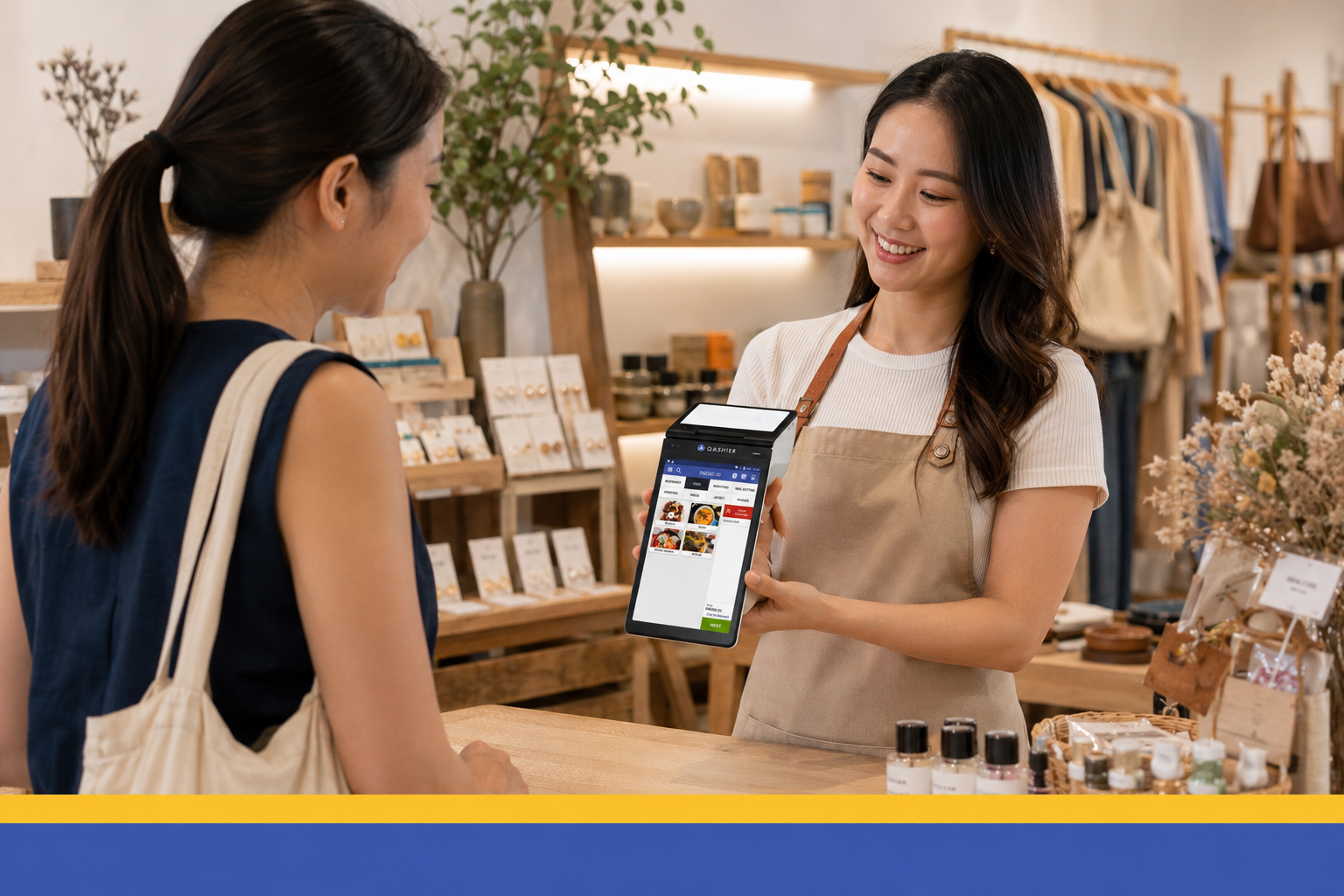
A customer asks whether you have the other size in stock. You tell her you will check. Checking means the stockroom, then the spreadsheet on your laptop, then a message to your other outlet to see whether they have one. Four minutes for a question that should have taken four seconds. She waits for two of them and then leaves.
That is not a stock problem. It is a systems problem. Your business runs on four separate tools that were bought at four different times for four different reasons: a POS for the counter, a portal from your payment provider for settlements, a spreadsheet for stock, and something else entirely for the customers you have collected over the years. Each one works. None of them work together.
The bill for that arrives in three currencies. Hours, because someone has to move information between systems every single day. Sales, because the four minutes it takes to answer a simple question is long enough to lose the transaction. And judgement, because when your systems disagree you stop trusting any of them, and you start running the business on instinct instead of numbers.
Below are the five places this costs you most, what causes each one, and what closes it.
You Do Not Have an Admin Problem. You Have a Handoff Problem.
The instinct is to blame the workload. More outlets, more staff, more transactions, more admin. That is not what is happening. The admin scales with the number of places your systems meet, not with the size of your business.
Every handoff is a job someone has to do. Sales figures to the stock sheet. Payout figures to the accounts. Customer names to the mailing list. Two systems create one handoff. Four systems create six. Add a fifth tool to solve a problem and you have just created four more handoffs to maintain. That is why buying another piece of software has never once made your evenings shorter.
What the Same Tuesday Looks Like on One Platform
A customer asks whether you have the other size. You check on the terminal in front of you, see two in your own stock and one at your second outlet, and tell her in four seconds. She buys.
The sale deducts from your stock count as it completes. She taps her card, QashierPay takes the payment, and Qashier Treats enrols her as a member because the loyalty is linked to the payment itself. Her profile now exists. Nobody asked her for anything.
By closing, your sales report is finished. Your stock count is current. Your settlement figure for the day matches your sales figure, because both came from the same system. There is no spreadsheet to update and no portal to cross-check.
Nine days later, Qashier Automated Marketing sends her a message about the points sitting in her balance and she comes back. None of that required a single manual action from you.
Closing the Day Once Instead of Twice
Most merchants close their day twice. Once at the till, when the takings are counted, and again a day or two later when the payout lands and the figures do not quite match. Then comes the part nobody accounts for: working out whether the gap is a refund, a fee, a timing difference or a mistake.
The cause is simple. Your POS is counting sales and your payment provider is counting settlements, and they are two different companies with two different definitions of a completed transaction. No amount of care at the counter fixes that, because the disagreement is structural.
QashierPay runs on the same platform as QashierPOS, so the sale and the payment are one record rather than two accounts of the same event. Settlement is T+1, so today's takings arrive the next business day, and the figure you see in your report is the figure that lands. Qashier holds a Major Payment Institution licence from the Monetary Authority of Singapore. Your reconciliation does not get faster. It stops existing.
Reordering From a Stock Count That Is Actually Current
You place an order on Monday based on a count you did on Friday. Three days of sales sit between the two, so you either over-order and tie up cash in stock that will not move, or under-order and run out on your busiest afternoon.
The cause is that your sales system and your stock record are not the same record. Every sale changes your stock position, but only one of those systems knows it happened, so a human being has to carry the information across. That human being is usually you, usually at night, usually tired.
QashierPOS deducts from stock as each sale completes. Your count is current at all times, not as of the last time someone sat down with a spreadsheet. When you reorder, you are working from what is actually on your shelves, and when a customer asks whether you have something, the answer is on the screen in front of you.
Knowing Which Staff Member, Which Outlet and Which Hour
Something goes wrong in a week and you cannot trace it. A discount was applied that should not have been. A void looks odd. Takings are light on a Thursday and nobody can say why. You end up asking people to remember things, which is not a control, it is a conversation.
The cause is shared logins and separate reports. If everyone uses the same account, the system records what happened but not who did it. If your outlets report separately, you cannot compare a Thursday in one against a Thursday in the other without building the comparison yourself.
Every staff member gets their own login on QashierPOS, so discounts, voids and refunds carry a name and a timestamp. QashierHQ shows every outlet in one view, by product, by hour, by staff member. Accountability stops being a matter of memory and becomes a matter of record, which is easier on everyone including the staff who did nothing wrong.
Sending a Promotion to the People It Was Meant For
You run a promotion. It goes to everyone on a list you built by hand, which means it goes to people who came in yesterday and people who have not been in for a year, with the same message. The people who were coming anyway get a discount they did not need. The people you actually wanted back never see it.
The cause is that your customer data was never attached to your sales data. A list of names and emails tells you who someone is. It does not tell you what they bought, when they last came in, or whether they are drifting away.
Qashier Treats builds the customer record at the point of payment, so every profile carries a purchase history without anyone typing anything. Qashier Automated Marketing then triggers messages off that behaviour rather than off a calendar:
- Welcome emails reach first-time customers while the visit is still fresh in their memory.
- Win-back messages go only to customers who have not returned within a period you define.
- Birthday offers arrive ahead of the date, personalised to that customer.
- Points reminders prompt customers sitting on an unredeemed balance to come and use it.
- Higher-value customers receive perks that recognise how much they already spend with you.
The discount goes to the person who needed a reason to return, and not to the person who was walking through the door regardless.
Seeing Your Second Outlet Without Driving to It
You know how the outlet you are standing in is doing. The other one, you find out about at the end of the week, or when someone calls you about it. So you drive over, or you call, or you wait, and by the time you know about a problem it has had three days to grow.
The cause is that reporting lives on the terminal instead of in the cloud. Each outlet holds its own numbers, and the only way to combine them is to ask each one and add them up.
QashierHQ puts sales, stock, staff activity and customer data for every outlet in one dashboard, on your phone. You can see which outlet is running short of something the other one is overstocked on and move it across instead of ordering more. Being physically present stops being the only way to know what is happening.
Everything Connects, Which Is the Whole Point
Removing four tools does not just remove four bills. It removes every handoff between them, and the handoffs were the actual work.
The payment enrols the loyalty member. The loyalty member creates the customer profile. The profile triggers the marketing. The marketing brings the customer back. The sale updates your stock, your report and your outlet view in the same moment. Nothing is carried from one system to another, because there is nowhere to carry it to.
The cost argument lands in the same place. Four separate tools mean four subscriptions, four renewal dates and four price rises you did not plan for. Qashier is S$5 a day with every feature included: point-of-sale, payments, ordering, bookings, loyalty, marketing and reporting. No feature tiers. No add-on you discover at renewal.
One login. One view. One platform.
Getting Started
QashierPOS, QashierPay, Qashier Treats, Automated Marketing, Treats Explorer and Spotlight are all available to Singapore merchants now, on one login and one bill, at S$5 a day with every feature included. Most merchants are trading on Qashier within a day, with existing product and customer data brought across during onboarding.
Book a free demo and get your evenings back before the end of the month.
Frequently Asked Questions
Why does running a small business take so many different systems?
Most businesses buy tools one at a time as problems appear, so a POS, a payment provider, a stock spreadsheet and a customer list end up owned by different vendors. Each tool solves its own problem but none of them share data, so a person has to move information between them every day. The admin grows with the number of connections between systems rather than with the size of the business.
How much time do disconnected business systems cost?
Most merchants running four separate tools spend three to five hours a week moving numbers between them, on top of the sales that get lost while someone checks stock or looks up a customer. The larger cost is decision quality, because stock counts and sales figures that disagree are figures you stop trusting. Consolidating onto one platform removes the transfers rather than making them faster.
Can one system handle POS, payments, inventory and loyalty in Singapore?
Yes. Qashier runs point-of-sale, payment acceptance, inventory, customer loyalty, automated marketing and reporting on one platform with one login. Because the sale, the payment and the customer are recorded as a single event, there is no syncing between tools and no reconciliation at the end of the day.
What payment methods does QashierPay accept in Singapore?
QashierPay accepts Visa, Mastercard and AMEX, plus PayNow, GrabPay, ShopeePay, Atome and Alipay+ along with other international e-wallets. Settlement is T+1, so your takings arrive the next business day. Qashier holds a Major Payment Institution licence from the Monetary Authority of Singapore.
Do I or my customers need to download an app?
No. Qashier runs in a web browser, and your customers do not need to install anything to join Qashier Treats. Loyalty enrolment happens through the payment itself at checkout.
How do I check sales across outlets without visiting them?
QashierHQ shows sales, stock, staff activity and customer data for every outlet in one dashboard, accessible from your phone. You can compare outlet performance by product, hour or staff member, and move stock between locations without being on site.
How much does an all-in-one business platform cost in Singapore?
Qashier costs S$5 a day in Singapore with every feature included. That covers point-of-sale, payment acceptance, ordering, bookings, loyalty, automated marketing and reporting on one plan. There are no feature tiers to upgrade into and no separate add-on charges.
What happens to my existing data when I switch systems?
Your product catalogue, staff accounts and existing customer records can be brought across during onboarding, so you are not rebuilding your business from an empty screen. Most Singapore merchants are set up and trading within a day.
Qashier is the all-in-one platform for merchants in Singapore and Southeast Asia: POS, payments, ordering, bookings, loyalty, marketing and more, all included at $5/day. Tell us what you run, and we'll build the rest.