If your business is stepping into the world of e-commerce, or selling online, the other thing you need to prepare is a sales strategy that gets customers engaged with your brand.
Setting up and running an e-commerce business is not easy these days. There is everything from choosing whether to use a platform or build your own website, to promotion, to running offers, to working out how to handle payments from a very large number of customers. Figures suggest the e-commerce market in South East Asia will add 0.7 billion users between 2024 and 2029, and that by 2029 there will be as many as 2.18 billion e-commerce users.
It is clear enough how much room there is to expand. Even so, you also have to face a saturated market and competition on both product range and price. The key to winning here is a customer engagement strategy — selling in a way that wins customers over.
In this blog we will look at how to win customers over and draw them in effectively, and at how Qashier POS can help you sell and turn ordinary customers into regulars.
What is a customer engagement strategy?
A customer engagement strategy is the way you connect customers to your brand, by building positive feeling towards it so that the relationship lasts and their needs are met, and by tailoring the product or the brand experience to the individual. Done well, it lifts your e-commerce business so that customers do not simply buy once and disappear but come back again, which gives you steady sales from old and new customers alike.
So how do you improve engagement with e-commerce customers?
Customers now tend to expect a brand to know what they want and to be able to support or advise them at every step of the purchase. Highly engaged customers spend more than the average, so here is how to draw them in and engage with them.
1. Engage with customers across every channel (omni-channel)
Customers may well approach a brand through several channels at once, or start on one channel and move to another. Surveys in Asia show that some customers browse products on a website and then go and buy in person in the shop — which differs from other countries, where they search for the product and buy online directly.
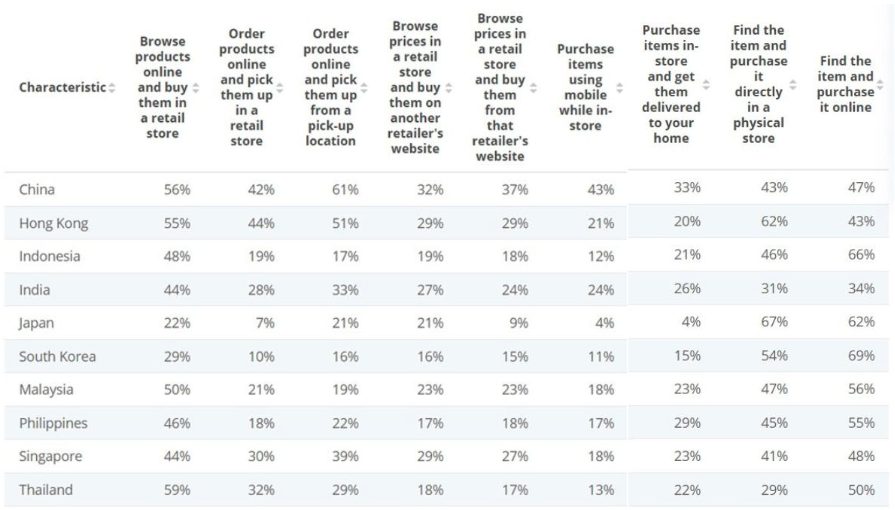
Source: Omnichannel retail usage in Asia as of November 2023, by country, Statista
The customer's experience across a brand's channels covers every interaction at every touchpoint: the website, social media, a mobile app, SMS, email, the physical shop, a stall, a live stream or the telephone. From the customer's side, 9 in 10 Gen Z and millennial customers approach a shop through several channels, from searching for the product through to reserving it and buying it.
So why has omni-channel e-commerce, or selling across several channels, become so central to a customer engagement strategy? Because your brand can send a consistent message across every channel and show that you are ready to serve on whichever one the customer chooses — letting them stay on that single channel rather than being pushed back and forth between them.
Beyond that, understanding the customer's path to purchase lets you tailor the buying experience to each individual — and tailoring matters a great deal to customers who use several channels. As a rule, customers who approach a shop through several channels buy 30 per cent more than the average.
2. Engage as actively as you would in the shop, with live chat and chatbots
A physical shop is usually known for serving its customers well, because a member of staff greets them and helps whenever they need it. E-commerce is no different: an outlet can use live chat so customers can talk to the seller in real time.
An e-commerce outlet without live chat risks losing its customers to a competitor that has it. The figures show live chat lifts customer satisfaction with an outlet by as much as 73 per cent, and it is also a useful tool for looking after a customer who is unhappy with what they bought.
In fact, 95 per cent of customers care more about the quality of the help they get than about speed. When you can solve a problem for a customer straight away, their trust in and satisfaction with the brand both rise, which turns into the next purchase — more than 63 per cent are likely to come back.
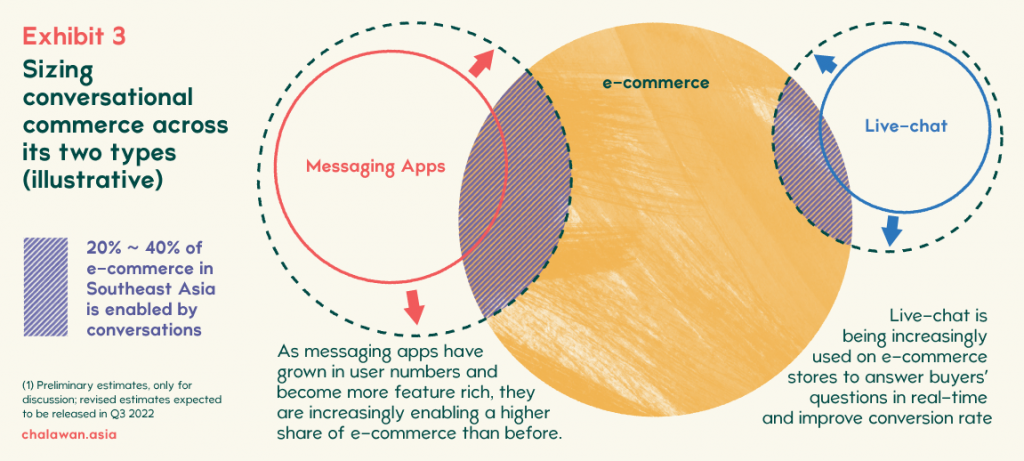
That said, there are limits to what ordinary staff answering live chat can do. It is worth considering a chatbot alongside live chat so customers get an answer immediately. This handles as much as 80 per cent of the general questions customers ask, and it makes it easier for staff to step in on the more complicated problems.
A chatbot may not be as clever as a person, but it can handle a great many basic questions and generate sales opportunities effectively. It reduces your running costs, helps promote new products, and — most importantly — keeps customers by being ready to respond 24 hours a day, every day.
3. A smooth checkout
Again and again a customer means to buy, then abandons a full basket at the last minute because the checkout got in the way.
Recent figures show that as many as 70 per cent of customers abandon the items they put in the basket. So how do you improve the customer's path from starting to shop to actually paying?
- Simplify the checkout page by stripping out everything that is not needed
- Adjust the payment process so customers are not confused into giving up
- Offer free delivery where you can — it cuts abandonment considerably
- Add live chat or a chatbot so help is immediate and questions get answered
- Offer a range of payment methods, including credit and debit cards, buy-now-pay-later, QR payment, digital wallets, bank transfer and cash on delivery (COD) where possible
4. Show your customer reviews — the bad as well as the good
Show customers the reviews left by people who have already bought from you. If you have a shopfront you can use your Google reviews for this, because customer reviews are an excellent way to build interaction and add value to your e-commerce brand's image.
It is worth thinking about how to encourage customers to write a review or post about your shop. If the budget allows, you can offer something in return, such as a voucher or a discount for customers who leave a review.
If a customer does write a negative review, use it to learn what left them unhappy. Apologise, show that you understand their reasons, and put it right straight away. It has been shown that returning customers spend three times as much as one-time buyers, or 67 per cent more on average — and if you find that a customer who was once unhappy is willing to buy from you again, try getting in touch and inviting them to review the shop once more.
Take the friction out of e-commerce selling with Qashier
Qashier connects to Shopify and WooCommerce. You can buy an add-on plugin to link Qashier with the system you already have, and that connection lets you manage your stock across the shop floor and online from the same database, bringing shop and online management together as one.
Start running your shop better with Qashier today
If you would like Qashier to be the helper your restaurant needs, do get in touch for more information. We are ready to support you with both POS terminals for restaurants and retail, capable POS software, and support from our team 7 days a week.
For more details, contact us on Line Official: @qashier.th or call 02 544 0267