
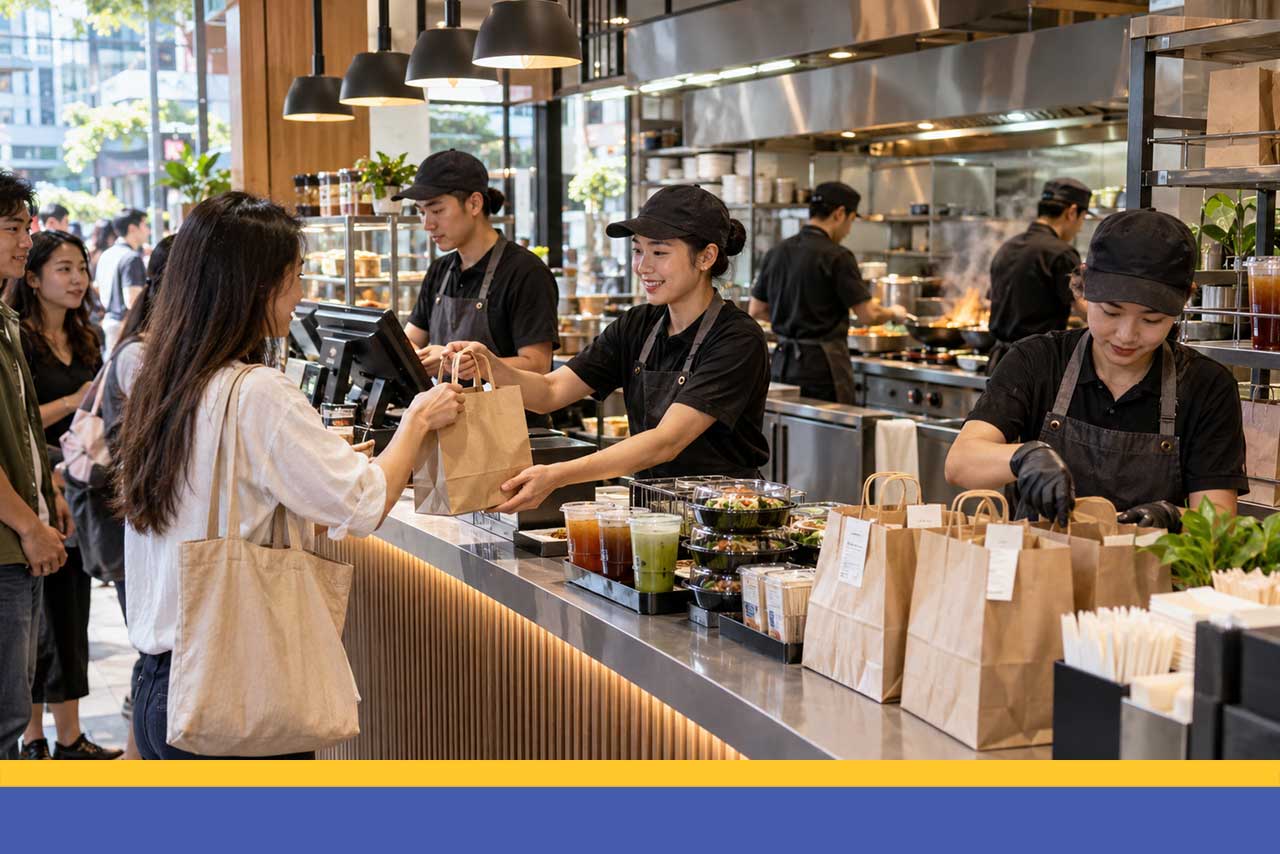
It is twenty past twelve. There are eleven people waiting, four of them looking at their phones and doing the arithmetic on whether they have time. Somebody comes back to the counter because their order was wrong, and for the next ninety seconds nothing else moves.
That is the entire economics of quick service in one moment. You are not selling food to people who are hungry. You are selling food to people who have a limited amount of time, and every second you take from them is taken from the thing they are actually buying.
This guide is for you if you run a takeaway, a food stall, a quick service counter or anything where customers order, wait briefly and leave. Your problems are different from a café's and very different from a restaurant's. You live on throughput, accuracy and ticket size, and most general advice ignores all three.
Below are the six areas that decide whether a quick service business makes money: speed, accuracy, ticket size, delivery channels, staffing to peaks, and the customers you serve constantly and never capture.
In Quick Service, Speed Is Not How You Deliver the Product. It Is the Product.
A restaurant sells an experience and time is part of the pleasure. You sell the opposite. Your customer has chosen you because you fit inside a gap in their day, and the moment you stop fitting, the decision reverses.
That has a hard consequence. Your capacity is measured in transactions per hour, not in seats or floor space, and your peak is short. If lunch is ninety minutes and you can process a transaction every forty seconds, your maximum revenue for that period is fixed by arithmetic. Everything that adds seconds reduces it, and everything that removes seconds increases it without costing you anything. That is a rarer kind of improvement than it sounds, and it is where most quick service businesses have the most unclaimed ground.
What a Lunch Peak Looks Like When It Works
At twenty past twelve there are eleven people waiting and the line is moving steadily, so nobody is doing the arithmetic about whether to leave.
Each order is rung up on QashierPOS with its modifiers, so a no-chilli, extra-rice version of your bestseller is the same item with variations rather than a separate product cluttering your reporting and confusing the kitchen.
Customers pay however they want on one terminal. QashierPay takes it and Qashier Treats enrols each of them through that payment, so nobody is asked to join anything and the line does not pause.
Stock deducts as each order completes, so by one o'clock you can see which item will run out before the evening without walking to the back. Nine days later a customer who came twice and stopped gets a message about the points sitting in her balance. None of that required a single manual action from you.
Find the Seconds, Because They Are Your Capacity
Time your own counter for ten minutes at peak and split each transaction into three parts: choosing, ringing up, paying. Most operators assume the delay is in choosing. It rarely is.
The delays are almost always in the middle and the end. An item that takes three taps to find because the menu was built around your categories rather than around what sells at lunch. A modifier buried two screens deep. A discount that needs someone senior. A payment method that lives on a second device. Each costs ten or fifteen seconds, and fifteen seconds at forty-second intervals is a transaction lost every three customers.
Reorganise the product screen around your peak, not your menu. Put your top ten lunch items on the first screen and everything else behind them. Set permissions so routine discounts do not stop the line. Keep every payment method on one terminal. And where you can, move ordering away from the counter entirely. QR code ordering, available as an add-on on your plan, lets customers order from where they are standing or sitting, which removes the longest part of the interaction from your busiest square metre.
The Wrong Order Costs Four Times What You Think
Accuracy is the least measured cost in quick service and one of the largest. A wrong order costs you the food, the remake, the queue time while it is sorted, and frequently the customer, who does not complain and simply does not return.
Most errors are not carelessness. They are structural, and they come from the same three places. Modifiers that are optional rather than forced, so a required choice can be skipped under pressure. Items created as near-duplicates, so the wrong one gets tapped. And a handover between counter and kitchen that relies on someone hearing something correctly during the loudest twenty minutes of the day.
Fix the structure rather than reminding people to concentrate. Make required choices required in the system so an order cannot be completed without them. Merge near-duplicate items into one item with variations. Make sure the ticket that reaches the kitchen carries the modifiers legibly rather than as an abbreviation only one person understands. Then, because every sale is recorded, you can look at which items generate the most remakes and treat that as a menu problem instead of a staffing one.
Ticket Size Is Where Quick Service Actually Grows
You cannot easily increase how many people come at lunch, because your peak is bounded by the clock and your capacity. What you can change is what each of them buys, and it is the cheapest growth available to you because it consumes no extra capacity at all.
The mistake is treating this as upselling, which staff dislike and customers resist during a rush. The version that works is structural. Look at what already gets bought together in your own sales data, then make those combinations easier to choose rather than asking anyone to persuade. Position the pairing as one tap rather than two decisions. Price the combination so the second item is an obvious yes rather than a considered purchase.
Then measure it. Average transaction value tracked weekly tells you whether a change worked, and attach rate by staff member turns a vague instruction into something you can coach and recognise. Most quick service businesses have never looked at either, which is why their ticket size has not moved in three years.
Delivery Platforms Are a Different Business, Not an Extra Channel
Delivery adds revenue immediately and cost quietly, and the cost arrives in three forms that are easy to miss.
The first is margin. Commission is deducted from a price you set for a different context, so a menu that works at your counter can be close to unprofitable through a platform. Compare what each channel pays you after commission rather than what it adds to your revenue line, because a channel producing your largest volume can be contributing the least profit.
The second is operational. A delivery order arriving during your lunch peak competes directly with the customer standing in front of you, and the two are not equal: one of them is watching you. Decide in advance which wins during peak, and be honest that accepting everything usually means serving both badly.
The third is ownership. A customer who orders through a platform is largely that platform's customer, so the channel fills your kitchen while building somebody else's database. That is not a reason to avoid it. It is a reason to capture the customers who do come to your counter properly, because those are the ones you can reach again for nothing.
Qashier's Food Delivery Integration is available as an add-on so delivery orders draw from the same stock count as your counter. Whatever you decide, both channels must work from one figure. Two versions of what you have left is how you end up cancelling a delivery order for something you sold at the counter four minutes earlier.
Staff to the Peak, Not to the Day
Quick service demand is not a curve, it is a spike. A daily total tells you almost nothing, because your business happens in two or three short windows and the rest is overhead.
Look at sales by hour and by day of week rather than by day. Most operators find two things at once: a shift staffed for demand that never arrives, and a forty-five minute window where they are losing transactions for want of one more pair of hands. Moving hours towards the spike costs nothing and is usually worth more than any other operational change available in a month.
The same view tells you when to prep. A kitchen prepping to a daily average will always be short at the peak and long at the end of service, and both of those are money.
You Serve Hundreds of People and Know None of Them
This is the quiet structural problem of quick service. Your transaction volume is high, your interaction is brief, and almost nothing about it leaves a record. You might serve four hundred people in a week and be unable to name one of them, which means every one of them is a stranger every time.
The consequence is that you have no way to grow except by being found again tomorrow. No way to tell whether last month's promotion brought back lapsed customers or discounted people who were coming anyway. No way to know how many of this month's customers had eaten with you before.
The fix has to be zero-effort or it will not survive a lunch peak. Qashier Treats is payment-linked, so the card someone taps enrols them inside a transaction that was going to happen anyway, with no app, no form and nothing asked at the counter. From there Qashier Automated Marketing can reach a customer at the point their usual gap ends, and Qashier Customer Reviews can prompt the happy ones for a Google review a few days later, which is what brings the next stranger through the door.
Everything Connects, Which Is the Whole Point
Look at those six again and notice that the same handful of decisions runs underneath all of them.
One item with modifiers rather than three near-duplicates makes the counter faster, the kitchen more accurate and the reporting readable. The payment sharing a platform with the sale removes a device from the counter and enrols the customer at the same time. Stock deducting as orders complete keeps your delivery channel honest and tells you what will run out before evening. Every sale carrying an hour and a staff member is what makes the staffing and attach rate questions answerable at all.
None of that is extra work during a lunch peak, which matters more here than in any other kind of business. Anything that requires attention at twenty past twelve will not happen.
One login. One view. One platform.
Getting Started
QashierPOS, QashierPay, QashierHQ, Qashier Treats, Automated Marketing and Customer Reviews are all available to Malaysian merchants now, on one login. Most merchants are trading within a day, with the menu and modifiers configured during onboarding.
Book a free demo and get more transactions through the same lunch peak.
Frequently Asked Questions
How do I serve more customers during a lunch rush?
Remove seconds from each transaction rather than adding staff, because your capacity at peak is transactions per hour. Reorganise the product screen around your top lunch items, keep modifiers one tap away, set permissions so routine discounts do not stop the line, accept every payment method on one terminal, and move ordering away from the counter where you can. Fifteen seconds saved per order is roughly one extra customer every three.
How do I reduce wrong orders in a quick service business?
Treat accuracy as a structural problem rather than a concentration problem. Make required choices mandatory in the system so an order cannot be completed without them, merge near-duplicate items into one item with variations, and make sure modifiers reach the kitchen legibly. Then review which items generate the most remakes, because that is usually a menu design issue rather than a staff issue.
How do I increase average ticket size?
Make existing combinations easier to choose rather than asking staff to upsell during a rush. Look at what already gets bought together in your own sales data, make that pairing one tap instead of two decisions, and price it so the second item is an obvious yes. Track average transaction value weekly and attach rate by staff member so you can tell whether it worked.
Are delivery platforms profitable for a takeaway business?
It depends on margin rather than volume, so compare what each channel pays you after commission instead of what it adds to revenue. Also account for the operational cost of delivery orders competing with your counter during peak, and remember that platform customers are largely the platform's customers rather than yours. Whatever you decide, both channels need to draw from one stock count.
How should I staff a quick service business?
To the spike rather than to the day, because quick service demand happens in two or three short windows. Look at sales by hour and day of week rather than daily totals, and expect to find both an overstaffed shift and a peak window where you are losing transactions. Moving hours toward the spike usually costs nothing and returns more than any other change in a month.
How do I build repeat customers when every visit is thirty seconds long?
Capture has to be effortless or it will not survive a peak. Payment-linked loyalty enrols customers through the card they were already paying with, so nothing is asked at the counter and no app is required. Once visits carry a customer, you can tell how many people are returning and reach the ones who have gone quiet.
What payment methods should a takeaway in Malaysia accept?
All of them, on one terminal. QashierPay accepts Visa, Mastercard and AMEX, along with DuitNow QR, GrabPay, ShopeePay, Touch 'n Go, Setel, Boost, Apple Pay and Samsung Pay, with T+1 settlement. During a lunch peak, reaching for a second device for one payment method costs you seconds you do not have.
Do I or my customers need to download an app?
No. Qashier runs in a web browser, so there is nothing to install and nothing tied to a particular device. Your customers do not need an app to join Qashier Treats either, because enrolment happens through the payment at checkout.