
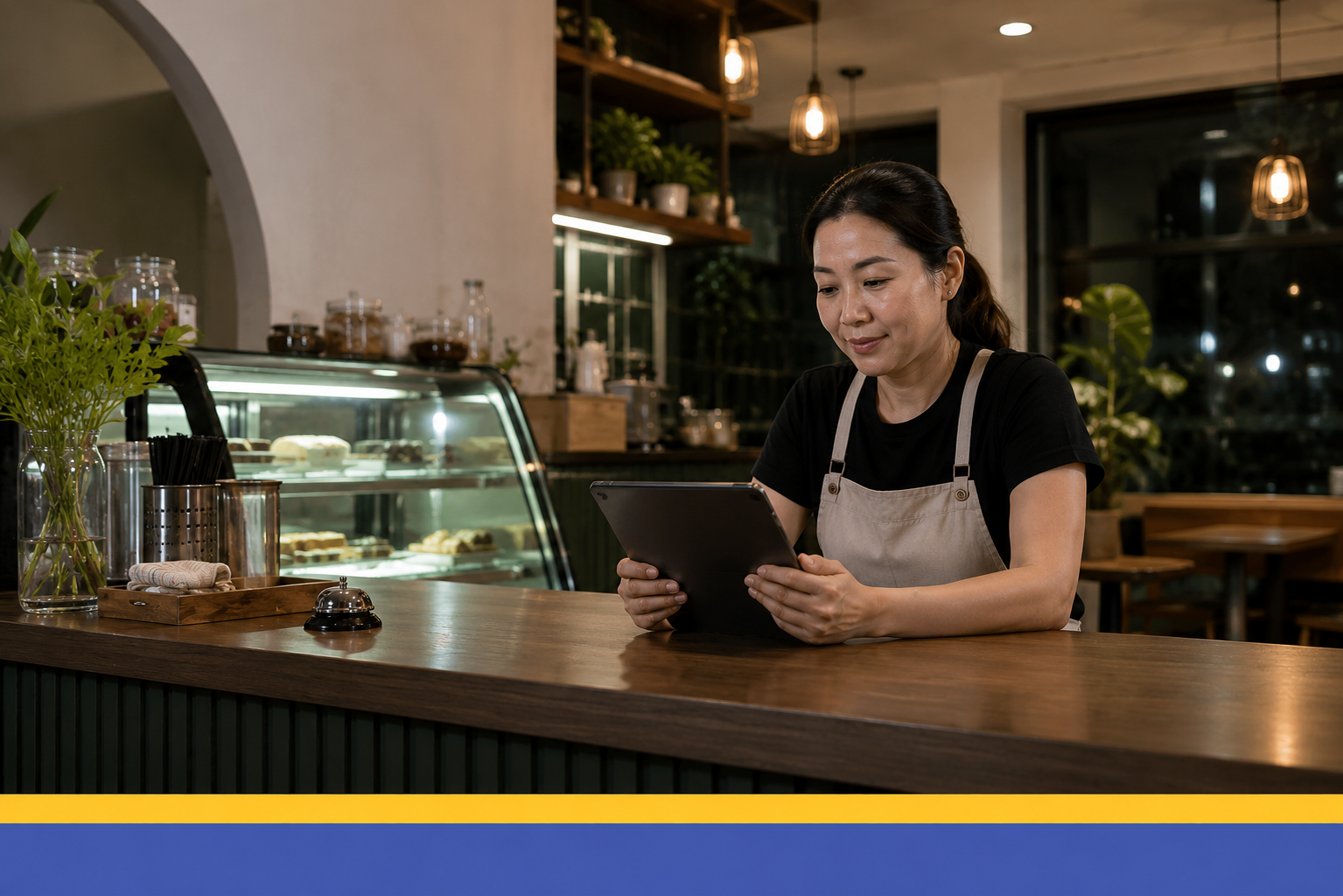
The shop closed forty minutes ago and you are still on the stool behind the counter with two devices open. The POS gives you today's sales. The payment provider's portal gives you today's payouts, and the two figures are close but not the same, so you will check again tomorrow. Stock is in a spreadsheet. Your regulars are in your phone, in your head and on a stack of stamp cards.
None of these systems talk to each other. So you talk to them, every night, one at a time. That is the job nobody warned you about when you opened.
The cost shows up in hours first. Three or four a week, gone to admin that produces nothing. Then it shows up in decisions. You reorder based on a stock count that is four days old, you run a promotion without knowing which customers it should reach, and you find out a product stopped selling three weeks after it stopped selling. Add a second outlet and every one of those gaps gets managed twice.
The businesses that grow fastest in Malaysia are not the ones working the longest hours. They are the ones who stopped doing this particular job entirely.
A POS Records the Sale. A Platform Records What Happens Next.
A point-of-sale system tells you what you sold today. An all-in-one business platform tells you what you sold, who bought it, whether they have been in before, what will bring them back and what that customer is worth over the next year. Same transaction, far more to work with.
The point is not more features. It is one source of truth. When your checkout, your payments and your customer records all write to the same place, your numbers agree with each other by default, and your evenings stop being an accounting exercise.
What an All-in-One Business Platform Actually Is
An all-in-one business platform runs your point-of-sale, payment acceptance, customer loyalty, marketing and reporting from one system with one login. The sale, the payment and the customer record are one event, captured once and visible everywhere.
Plenty of setups get called all-in-one without being it. Three common ones:
- A POS with a long list of third-party integrations still leaves you with several vendors, several logins, several bills and several support numbers when something goes wrong at six in the evening.
- A POS paired with a separate card terminal from another provider means your sales figures and your settlement figures come from two companies who count differently.
- A POS beside a standalone loyalty app asks the customer to do extra work at the counter, which is exactly why most loyalty programmes never reach the enrolment numbers that make them worth running.
Integration means two systems agreeing to swap data. A platform means one system that never needed to.
Here Is How It Works Across a Single Day
A new customer walks in at ten. She orders, you ring it up on QashierPOS, and she pays by DuitNow QR. QashierPay takes the payment and Qashier Treats enrols her at the same time, because loyalty is linked to the payment. Nobody asked her to download an app or fill in a form. She leaves with points and a customer profile she does not know she has.
The sale deducts from your stock as it completes. Your sales report updates immediately. Her spend and her items attach to her profile.
Ten days later she has not come back. Qashier Automated Marketing picks that up and sends her a message about the points waiting in her balance. She returns the following week and spends more than the first time, because the hardest decision, whether to try you at all, was already made.
That night you open QashierHQ on your phone, see both outlets in one view, and notice one branch is selling twice as much of an item as the other. You move stock across instead of ordering more. None of that required a single manual action from you.
Your Checkout, Your Stock and Your Staff Records Update Together
QashierPOS records the sale, and the sale does the rest of the work. Stock levels, daily sales figures and the record of which staff member served that customer all update in the same moment, with nothing to reconcile afterwards.
You get an accurate stock position and an accurate sales position at the same time, which is rarer than it sounds. Shortages stop surprising you at the point of reorder. Staff get their own logins, so end of shift is a matter of record rather than trust. And reports are ready when you want them instead of after an hour of assembly.
Your Customers Pay However They Want, and the Money Lands the Next Business Day
QashierPay accepts Visa, Mastercard and AMEX, DuitNow QR, GrabPay, ShopeePay, Touch 'n Go, Setel, Boost, Apple Pay and Samsung Pay. Malaysian customers are used to paying with whatever is already open on their phone, and a business that says no to one of those methods loses the sale to the one next door that says yes.
Settlement is T+1, so what you take today is in your account the next business day. Because the payment runs through the same platform as the sale, your settlement report and your sales report come from one source, and the monthly exercise of working out why two numbers disagree simply stops.
Loyalty That Signs Customers Up Without Asking Them to Do Anything
Qashier Treats is payment-linked. The card or wallet your customer pays with becomes their loyalty identity, so enrolment happens inside a transaction that was going to happen anyway. No app download. No stamp card lost in a handbag. No asking someone to sign up while a queue builds behind them.
That is why payment-linked loyalty enrols far more customers than app-based programmes. The friction that kills most schemes is gone. Your customer database then builds itself, one sale at a time, and it belongs to you rather than to a platform that also serves the shop across the road.
Marketing That Runs Off What Your Customers Actually Do
Qashier Automated Marketing sends messages triggered by real behaviour at your counter, not by a content calendar you have to keep up with. You set it up once in QashierHQ and it keeps working:
- Welcome emails reach first-time customers while the visit is still fresh.
- Win-back messages go out when a customer has not returned within a window you choose.
- Birthday offers arrive ahead of the day, personalised to that customer.
- Points reminders nudge customers sitting on a balance they have not redeemed.
- Your highest spenders get perks that recognise what they already spend with you.
None of that is possible if your email tool and your POS are strangers. It works here because the sale, the payment and the customer profile are one record.
New Customers Find You Without You Buying Reach
Treats Explorer puts your business on a discovery map inside the Treats app, where customers browse nearby merchants to find somewhere to spend and earn points. Those customers arrive warm. They were looking, not being interrupted.
Qashier Spotlight gives you a branded microsite with one shareable link for your promotions, socials and business details. Put it in your Instagram bio and your WhatsApp Business profile and it does the work of a website without the cost of one. Qashier Customer Reviews asks your happiest customers for a Google review at the moment they are most likely to write a good one, which lifts your local search visibility month after month.
Everything Connects, Which Is the Whole Point
Any one of these is a decent tool on its own. The compounding starts when they share a database.
The payment enrols the loyalty member. The member becomes a customer profile. The profile triggers the marketing. The marketing brings the customer back. The return visit makes the profile sharper, which makes the next message land better. All the while the sale is updating your stock, your reports and your outlet view without a spreadsheet in sight.
The cost argument lands in the same place. Four separate tools mean four subscriptions, four renewal dates, four support numbers and four price rises you did not plan for. Qashier starts at RM5 a day on the Essential plan and RM8 a day on Growth. Anything you switch on beyond that, from Qashier Treats and Qashier Bookings to QR code ordering and your accounting, e-commerce or food delivery integrations, comes at a small daily price on the same bill and the same login. You add capability without adding a vendor.
One login. One view. One platform.
Does Your Business in Malaysia Actually Need One?
Not on day one, necessarily. If you take a small number of transactions, sell one product line and have no plans to build a customer base, a simple till will hold for now.
You need an all-in-one platform when any of this sounds familiar. You spend more than two hours a week moving numbers between systems. You cannot say how many of last month's customers had bought from you before. Your stock count and your sales figures disagree often enough that you no longer trust either. Or you are opening a second outlet, where every weakness in your current setup gets duplicated rather than solved.
Getting Started
QashierPOS and QashierPay are available to Malaysian merchants now, from RM5 a day on the Essential plan and RM8 a day on Growth. Treats, Bookings, QR code ordering and your integrations switch on as add-ons for a small daily price, on the same login and the same bill. Most merchants are up and trading within a day.
Book a free demo and see your whole business on one screen before you commit to anything.
Frequently Asked Questions
What is an all-in-one business platform?
An all-in-one business platform runs your point-of-sale, payment acceptance, customer loyalty, marketing and reporting from a single system with a single login. One system records the sale, the payment and the customer at the same moment, instead of separate tools passing data between them. The result is one accurate view of your business rather than several partial ones.
How much does an all-in-one POS system cost in Malaysia?
Qashier starts at RM5 a day on the Essential plan and RM8 a day on the Growth plan. Add-ons including Qashier Treats, Qashier Bookings, QR code ordering and integrations with your accounting, e-commerce and food delivery platforms are available for a small daily price on top. Everything appears on one bill and runs from one login.
What is the difference between an all-in-one platform and a POS with integrations?
Integrations connect separate products owned by different companies, so you still deal with several vendors, logins and bills, and data can drift out of sync. An all-in-one platform keeps everything in one database, so there is nothing to sync and one team to call for support.
What payment methods does QashierPay accept in Malaysia?
QashierPay accepts Visa, Mastercard and AMEX, along with DuitNow QR, GrabPay, ShopeePay, Touch 'n Go, Setel, Boost, Apple Pay and Samsung Pay. Settlement is T+1, so your takings arrive the next business day. Every method is accepted on the same terminal and reported in the same place.
Do I or my customers need to download an app?
No. Qashier runs in a web browser, and your customers do not need to install anything to join Qashier Treats. Loyalty enrolment happens through the payment itself at checkout.
Can I run more than one outlet from one account?
Yes. QashierHQ shows sales, stock, staff activity and customer data across every outlet in one dashboard. You can compare outlets, move stock between them and see the whole business without driving to each branch.
Is the loyalty programme a separate subscription?
Qashier Treats is an add-on to your Qashier plan for a small daily price, not a separate product from a separate vendor. It runs on the same platform and the same login as your POS and payments, so your loyalty data and your sales data stay in one place. You switch it on when you want it and it appears on the same bill.
How long does it take to switch from my current POS?
Most Malaysian merchants are set up and trading on Qashier within a day, including product catalogue and staff accounts. Existing product and customer data can be moved across during onboarding, so you are not starting from an empty system.