
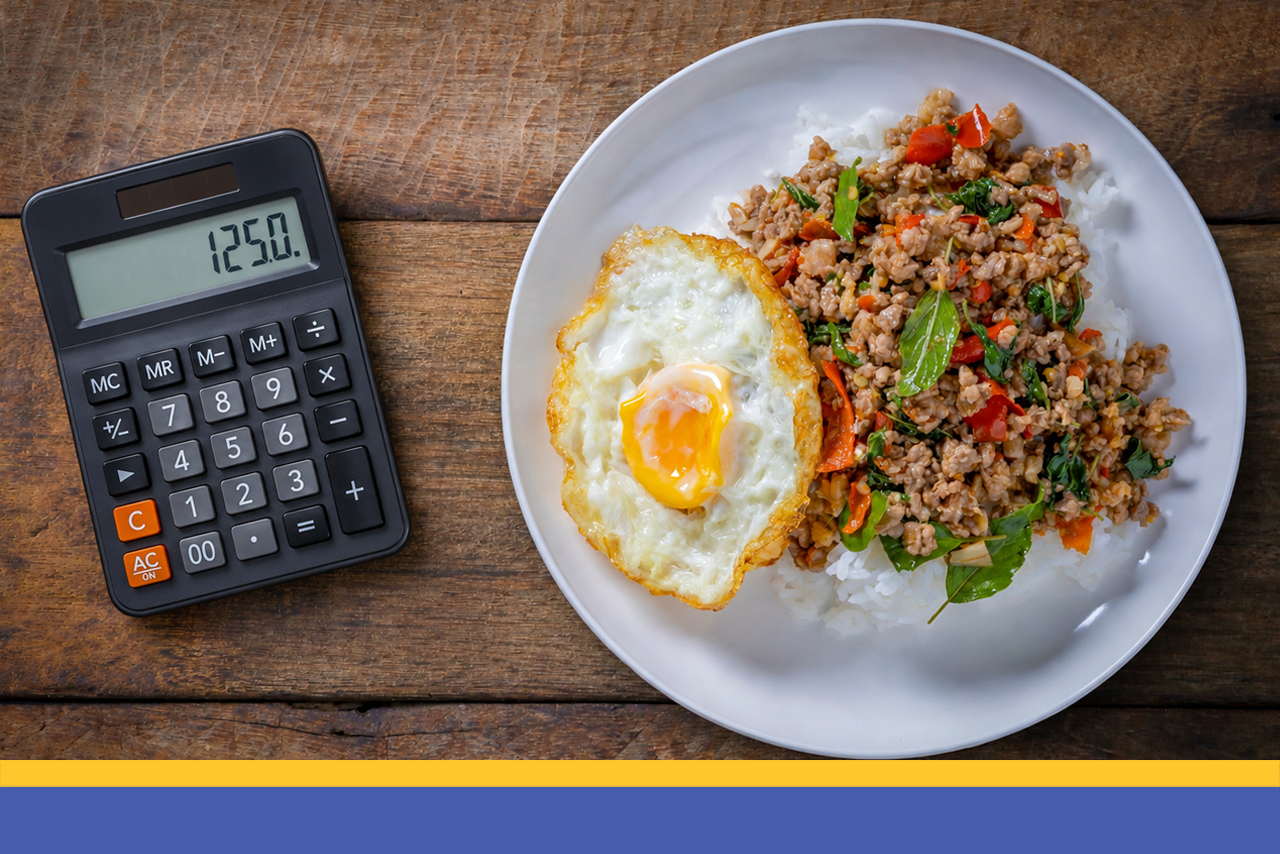
Picture this. Your shop sells over a hundred plates of minced pork pad kra pao a day. There's always a queue and the reviews are good. But at the end of the month, the books show less profit than there should be, and some months you barely break even. If that sounds familiar, the problem may not be sales. It may be that you've never known your real cost per plate.
Many owners set menu prices by feel: "The shop next door charges 60 baht, so we'll charge 60 too", or "This price should make a profit." They never actually work out how many baht each plate leaves them. The result: a shop can sell very well but make so little profit it barely shows. Worse, it can lose money for months without anyone noticing. This article walks you through calculating food cost step by step, with real numbers, so you can price your menu with confidence instead of guessing.
What is food cost, and why does every owner need to know it?
Food cost is the share of a dish's selling price that goes on ingredients. Put simply: "Out of every baht the customer pays, how much goes on ingredients?" This number matters because it's at the heart of pricing your menu for the right profit: not so high that customers won't buy, and not so low that you lose money while selling well.
The right food cost varies a lot between types of restaurant. It depends on the ingredients (expensive meat pushes food cost higher than vegetable dishes), your pricing strategy and your other overheads. The restaurant industry often talks about a broad range of roughly 20% to over 35%. But the "best" number for your shop may not match anyone else's. What matters more is knowing the real number for each dish and using it to make informed decisions, not borrowing someone else's figure.
A worked example, step by step: minced pork pad kra pao with fried egg
Let's calculate the food cost of minced pork pad kra pao with a fried egg, selling at 60 baht.
Step 1: Set a standard recipe and the quantity of each ingredient per plate.
Before you calculate anything, you need a standard recipe that states exactly how much of each ingredient goes into one plate, not a guess by eye. Say your recipe is:
- Minced pork, 100 g
- Garlic, chilli and holy basil
- 1 egg
- 1 plate of steamed rice
- Seasonings (soy sauce, fish sauce, oyster sauce, sugar, vegetable oil)
Step 2: Work out the cost of each item from what you actually pay.
Divide what you actually pay for each ingredient into the cost per unit you use. For example:
Item | Cost per plate (THB) |
|---|---|
Minced pork, 100 g | 8 |
Garlic, chilli, holy basil | 3 |
1 egg | 5 |
1 plate of steamed rice | 4 |
All seasonings | 5 |
Total ingredient cost per plate | 25 |
Step 3: Calculate the basic food cost.
Food cost = (25 ÷ 60) × 100 = 41.7%
Step 4: Check whether hidden costs are included.
This 41.7% is only the raw food cost. It doesn't yet include the other hidden costs of making this dish, such as cooking gas, electricity, water, takeaway packaging and waste from prep. Most shops overlook these (more on this below).
Step 5: Compare the number with your selling price and decide.
Once you know the real food cost, compare it with your profit target. Then decide whether 60 baht is the right price, or whether to adjust the recipe, the portion or the price.
Why so many shops get food cost wrong
The main reason a shop's own food cost figure is off is forgetting these hidden costs.
Cooking gas, water and electricity
Stir-frying, deep-frying, boiling and reheating all use energy that costs money. It looks small per plate, but multiplied by a month of orders it's a cost you can't ignore, especially for dishes that take a long time, such as soups and braises.
Packaging for takeaway and delivery
Food boxes, plastic bags, cutlery and sauce sachets are a real cost on every takeaway order. Yet many shops cost a dish the same whether it's eaten in or taken away. That makes the food cost of delivery orders look lower than it really is.
Waste and shrinkage
Vegetable trimmings, offcuts from meat, ingredients that spoil before you use them, and dishes made wrong that have to be redone: all of these are real costs that never get sold. If you work out costs as "purchase price divided by the exact amount the recipe needs" without allowing for waste, your food cost will come out much lower than reality.
Prep labour
This isn't part of the basic food cost formula. But the time staff spend chopping, prepping and marinating is a cost to bear in mind when pricing dishes with especially complex prep.
Once these hidden costs are added in, many shops find their real food cost is quite a bit higher than they thought. That may explain why sales are good but profit falls short.
Food cost for 3 example dishes
Here's a worked comparison of three hypothetical dishes that a typical restaurant or café might sell.
Dish | Ingredient cost per plate (THB) | Selling price (THB) | Food cost (%) | Gross profit per plate (THB) |
|---|---|---|---|---|
Iced latte | 25 | 65 | 38.5% | 40 |
Minced pork pad kra pao with fried egg | 25 | 60 | 41.7% | 35 |
Som tam Thai | 20 | 50 | 40.0% | 30 |
The iced latte has a similar food cost percentage to the other two dishes, yet it makes the most gross profit per plate. That's why looking at food cost percentage alone isn't enough. Always look at gross profit in baht too. A dish with a higher food cost percentage can still make more baht than one whose percentage looks better, depending on its price and how many you sell each month.
How to set menu prices so you don't lose money
Once you know your real costs, the next step is setting a price that covers ingredients, hidden costs and your profit target. A popular method is to set a target food cost in advance, based on your type of shop and pricing strategy, then work backwards to the selling price:
For example, if your target food cost is 30% and a dish costs 24 baht including hidden costs, the price should be 24 ÷ 0.30 = 80 baht. This formula means you no longer guess prices at random. It also gives you a clear method every time you add a dish, or when ingredient prices rise and you need to review your prices.
Your target food cost doesn't have to match anyone else's. A shop selling premium meat dishes may accept a higher food cost because its prices are higher too. A drinks or snack shop may aim lower to cover other costs. Work from your own real costs and profit target rather than copying another shop's numbers.
Menu pricing psychology: same number, different sales
Beyond the maths, how you present prices on the menu also shapes what customers choose.
Price anchoring means placing a high-priced item on the menu as a reference point, so the items below it look more reasonable and appealing. For example, put a premium set at the top of a category, followed by the regular sets.
Prices ending in 9, such as 59 baht instead of 60, are a widely used pricing technique. The brain tends to read numbers from left to right, so 59 baht feels cheaper than 60 by more than the real 1 baht difference.
Menu engineering means putting high-margin dishes where customers' eyes land first, such as the top-right of the menu or a highlighted box. That raises the chance customers pick the dishes that earn you more, without discounting or pushing. It only works when you know each dish's real profit first. Otherwise you may end up highlighting a dish that sells well but makes very little.
Qashier shows you the real numbers instead of guesses
Calculating food cost accurately needs several pieces of data at once: ingredient cost per plate by recipe, hidden costs that move with market prices, and real sales of each dish. Doing that by hand or in a spreadsheet every month is slow and easy to get wrong.
A POS such as Qashier has recipe-level inventory. You set up each dish's standard recipe and ingredient quantities in advance, and stock is deducted automatically by recipe every time you sell. So your real ingredient cost per plate comes from actual sales data, not estimates. Real-time sales and profit reports by dish show you which dishes make good money and which need a price or recipe review, without waiting to go through the books at month-end. And for multi-outlet businesses, managing menus and prices centrally lets you update prices quickly and consistently across every outlet when costs change.
If you've been pricing by feel or by copying competitors, start by calculating the real food cost of 2–3 of your best sellers using the steps above. Then consider how much time and guesswork a POS like Qashier could save you by showing cost and profit per dish in real time. Contact the Qashier team today for advice and a demo of this feature.
FAQ
1. What counts as a good food cost? There's no single number that works for every shop. It depends on your menu, pricing strategy and other costs. The industry often talks about a broad range of roughly 20% to over 35%. What matters more is knowing your own real number and setting a target that fits your business.
2. How often should I calculate food cost? At least whenever a key ingredient's price changes significantly, and whenever you add a new dish. Also review the overall picture regularly, such as monthly, to catch cost changes before they eat into several months of profit.
3. Do hidden costs like gas and waste need to be 100% accurate? Not at first. Estimating them as a percentage on top of raw ingredient cost, for example based on your monthly overheads, already brings your food cost much closer to reality than ignoring them. Refine it as you gather more data.
4. Why are sales good but profit lower than expected? A common cause is pricing without ever calculating real costs, or forgetting hidden costs such as ingredient waste and packaging. Real food cost ends up higher than you think, so good sales don't turn into the profit they should.
5. Should every dish have the same food cost? No. Many shops mix it up: some dishes carry a higher food cost to draw customers in (signature or value dishes), while others carry a lower food cost to balance things out. Look at gross profit across the whole shop, not each dish on its own.
6. How can a POS help with food cost? A POS with recipe-level inventory deducts ingredients by standard recipe automatically every time you sell. Cost per plate comes from real sales data instead of hand estimates, and profit-by-dish reports help you see the big picture faster and adjust prices or recipes in time.
In summary
- Food cost is ingredient cost as a share of the selling price: (ingredient cost per plate ÷ selling price) × 100.
- Your ingredient cost per plate must include hidden costs such as gas, packaging and waste, not just raw ingredients.
- There's no fixed "best" food cost. It depends on your type of shop and pricing strategy.
- Good pricing combines cost calculation with pricing psychology, such as price anchoring and menu engineering.
- A POS with recipe-level stock and real-time profit-by-dish reports shows you real numbers instead of guesses.
Run your shop better with Qashier, starting today
If you'd like Qashier to help run your restaurant, get in touch. We can help with a restaurant POS or a POS for shops, and support from our team 7 days a week.
Find out more on LINE Official @qashier.th or call 02 544 0267.