
If you are just starting out in business and thinking about using a POS terminal and system instead of ringing things up by hand, the sheer volume of information and unfamiliar vocabulary can make your head spin. Some of the terms you will know; others you will not. So let us get to grips with the vocabulary around POS terminals properly, so that you understand each term correctly.
Here are the terms we are going to cover today.
POS
POS stands for Point of Sale. It is the front-of-house sales system that sits at the point of sale or the point of payment — the one you see at the counter of a shop, or at the cashier.
A POS does more than take payment. It comes with a range of capabilities and features too: showing your sales figures, checking stock levels, membership schemes, loyalty points and so on.
You may hear people talk about both a POS terminal and a POS system. The distinction is exactly what it sounds like: the POS terminal is the physical device you work on, and it comes in a number of different models, while the POS system means the front-of-house sales software — the operating system, in effect. To put it simply, it is much like a Samsung phone running Android 6.0: you need the two of them together for either to work to its full potential.
QR Code
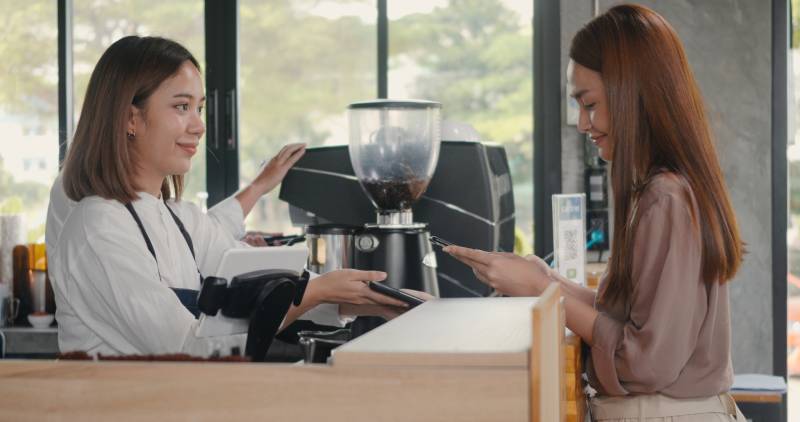
QR stands for Quick Response. The term usually refers to the square symbol used to stand in for a piece of data, and you normally need a camera to scan and read it. A QR code can link through to a website, and if you scan it with a banking app it can be used to make a payment — the method everyone in Thailand knows as “scan to pay”.
Dynamic QR Code
This is a QR code that can do more than an ordinary one, because it can carry specific values within itself. It can be scanned and used for a single transaction only; if you want to run another transaction, a new QR code has to be generated.
A Dynamic QR code is more sophisticated and more secure, and generating one normally requires a system to produce it. For shops, Dynamic QR is most often used to take payment — generating a QR code for the amount due and having the customer scan it — or to generate a QR menu that customers order from.
If your shop wants to use Dynamic QR to take payment from customers, you can do it easily through Qashier POS, which makes scan-to-pay straightforward.
PromptPay
PromptPay is a payments infrastructure that gives people another way to transfer money, using a national ID number, a mobile phone number or a bank account number, through digital channels.
Once a shop has registered for PromptPay, it can accept scan-to-pay through a mobile phone app, which is more convenient for buyer and seller alike.
PromptPay is only one provider among several. There are a number of others, each with its own terms and its own service.
EDC
EDC, the card terminal, stands for Electronic Data Capture. It is a device built to accept payment in a range of forms — credit card, mobile banking, QR scan and whatever else the system supports.
Debit
As a card, a debit card is one you pay with using money already in your account, up to whatever balance that account holds.
In accounting, the debit is the left-hand side of the ledger, used to record increases in assets and expenses. It is abbreviated to Dr.
Credit
Credit is an arrangement that lets the borrower buy goods or services now and pay for them later — the familiar case being the credit card, where you buy first and settle up afterwards.
In accounting, the credit is the right-hand side of the ledger, used to record increases in liabilities and income, or decreases in assets. It is abbreviated to Cr.
There is another sense of “credit” in retail, where the buyer buys “credit” from the shop and holds it, then spends that credit on purchases later on, whenever they want to.
Transaction
A transaction is an exchange that has taken place. It usually means a single exchange — a single sale — so however many items are bought, that still counts as one transaction.
Transactions matter enormously in business. You should record every one of them, because doing so confirms that each entry is correct, and it feeds your sales reports, your profit and loss, and much else. Using a POS system for your sales makes recording transaction data far easier.
Inventory
Inventory means the stock a business holds. It covers finished goods ready for sale, goods still in production, and the raw materials used to make them.
It sounds a lot like stock, but stock counts only finished goods ready to sell — so stock is really a subset of inventory. That means inventory management covers rather more ground than stock management, although in Thailand people have long since come to use “stock” for both.
With Qashier POS, inventory management covers both the stock on your shelves and the running of the business itself.
Invoice
An invoice is the document used to bill a customer and ask them to pay at a later date. It sets out the details — the goods or services supplied, the amount due, the seller's and buyer's details and so on — as a record of the transaction.
Invoicing matters especially when you are trading with companies, because an invoice is an important business record and has to carry accurate information. A number of POS systems can produce invoices, Qashier POS among them.
Loyalty
This can mean either customer loyalty or a loyalty programme.
Customer loyalty is the loyalty a customer feels towards a brand, shown through repeat visits, through taking part in the brand's activities, through the confidence and trust they place in it, and ultimately through recommending it to other people.
A loyalty programme is a scheme designed to maintain the relationship between a brand and its customers. Loyalty programmes come in many forms, from points cards to cashback schemes to stamp collecting.
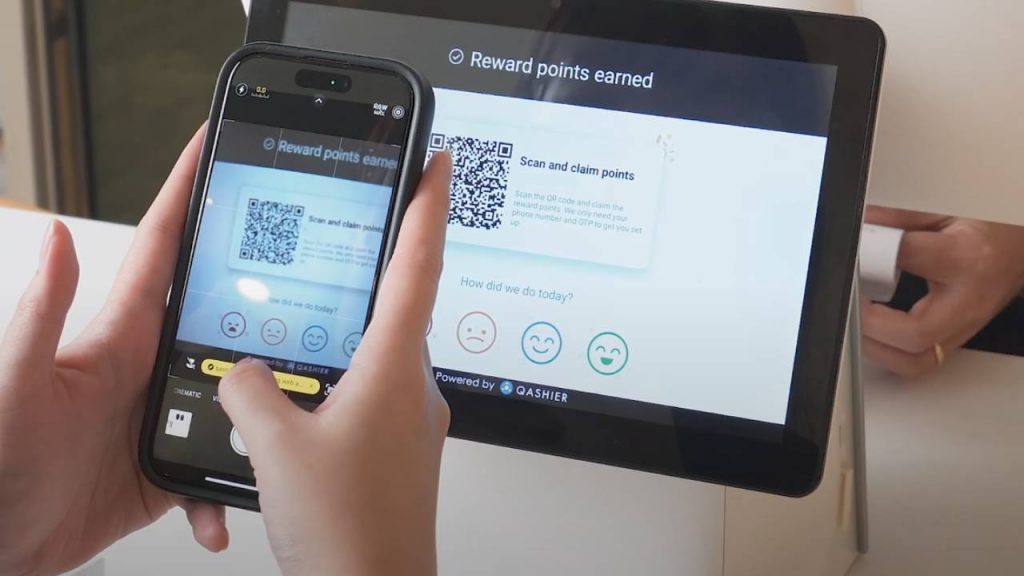
Either way, both matter in running a business. POS systems do not usually come with a loyalty programme worth getting excited about, and shops often have to buy one from a third party. Qashier POS is the exception: we built Qashier Treats, a loyalty points system that customers redeem for discounts by scanning a QR code, and it is built into Qashier POS itself.
CRM
Customer Relationship Management is the practice of managing your relationships with customers on the principle that the customer comes first — and that, in turn, is what earns their loyalty.
KDS
A Kitchen Display System is the technology used to display incoming food orders in a restaurant. Typically, when a customer orders through the POS, the order details are sent straight to the KDS screen in the kitchen, so the kitchen can cook to the orders it receives without any friction.
For example, a member of staff at the counter takes the order on Qashier POS; the moment they confirm it, the order appears on the KDS screen in the kitchen. Nobody has to print an order slip and walk it over, the status of every order is clear on screen, and there is no worry about an order going missing.
Qashier POS
Qashier POS is a shop management POS system that supports many kinds of business — restaurants, coffee shops and cafés, retail shops, and also salons, nail bars, massage shops and more. A complete set of core features and a system that is easy to use make running your business that much smoother.
QashierHQ
The back office for Qashier POS. Shops using Qashier POS can log in through the website to edit and manage the various parts of their shop's data — product lists, promotion details and so on.
Those are the basic terms anyone opening a shop ought to know. Once you have them straight, running your shop — right down to using a POS terminal and a shop management system — becomes a great deal easier.
Start running your shop better with Qashier today
If you would like Qashier to help your business, get in touch with us for more information. We are ready to support you, whether with POS terminals for restaurants or for retail shops, an effective POS system, and support from our team seven days a week.
For more details, contact our Line Official: @qashier.th or call 02 544 0267