
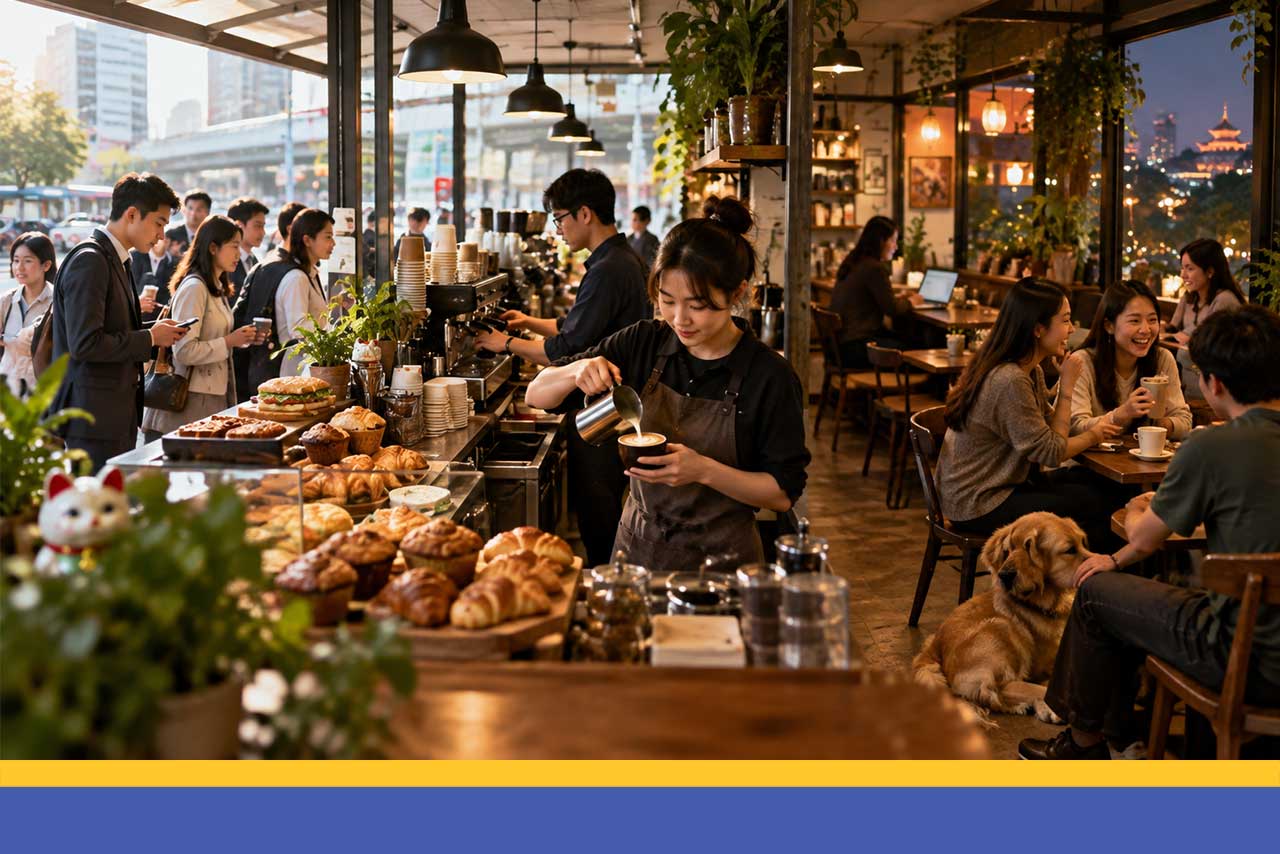
This guide is for you if you run a café, or are about to, and have realized that almost none of the general business advice available to you accounts for how a café actually behaves. Your day is not a day. It is ninety minutes that decide the month, followed by six hours of something else entirely.
At twenty to eight there is a line to the door. By eleven the room is half empty. Between two and four you have staff, rent and equipment running at close to full cost against a fraction of the revenue. Then a second, smaller lift, and you close.
That shape creates a specific set of problems. Your margin is decided by drinks most owners have never costed properly. Your waste is measured in liters of milk and trays of pastries nobody counted. Your revenue depends on frequency rather than footfall, and frequency is the one thing almost nobody measures. With supplier costs rising and a large share of your discovery happening on social rather than on the street, none of those are small problems.
This guide covers the seven areas that decide whether a café makes money: the rush, your menu margin, waste, your regulars, the dead hours, your team, and everything that arrives through a screen rather than a door.
A Café Does Not Sell Coffee. It Sells the Same Cup to the Same Person Two Hundred Times a Year.
Most cafés are run as though the goal is to serve as many people as possible. It is not. The goal is to be a habit, because a habit is worth two hundred visits a year and a good visit is worth one.
That single reframe changes what matters. It means the customer who came once and loved it is worth far less than the one who comes three mornings a week and has never thought about you at all. It means your marketing budget is better spent shortening the gap between visits than widening your reach. And it means the most valuable thing your business can know is not how many people came in, but how many of them had been in before. Almost no café can answer that, which is why almost every café markets to strangers.
What a Morning Looks Like When the Café Runs Itself
At twenty to eight there are nine people in the line and it is moving. Each drink is rung up on QashierPOS with its modifiers, so an oat flat white is the same product with a variation rather than a separate item cluttering your reporting.
Customers pay and go. Each receipt prints with a QR code, so a customer signs up for Qashier Treats with her mobile number in her own time rather than at the counter, and the line does not slow down.
The milk deducts as each drink is made. By ten you can see on your phone that one pastry line will run out before lunch and another will not sell through.
Nine days later a customer who came twice and then stopped gets a message about the points sitting in her balance, and she comes back on Thursday. None of that required a single manual action from you.
Your Morning Rush Is the Whole Business
Work out what share of your daily revenue happens between seven and half past nine. For most cafés it is somewhere between a third and a half. Everything you do to that ninety minutes is worth several times what you do to the rest of the day.
The constraint is almost never the number of people behind the counter. It is seconds per transaction. A drink that takes three taps to find because the menu was built badly, a modifier buried two screens deep, a loyalty card being stamped, a second device for a payment method: each costs ten or fifteen seconds, and fifteen seconds across a morning line is a customer at the back deciding to go elsewhere.
Fix the counter before you fix anything else. Organize your product screen around what actually sells at eight in the morning rather than around your menu structure. Set permissions so a routine discount does not need you. Keep your stock count live so nobody walks to the back to check. And put the loyalty sign-up on the receipt, so nothing is added to the transaction at exactly the moment you cannot spare it.
Your Bestselling Drink Might Be Your Worst
Cafés are unusually good at knowing what sells and unusually bad at knowing what earns. The two are frequently different drinks.
The reason is that cost sits in the parts nobody itemises. Milk is the largest variable cost in most cafés and it varies enormously by drink. A large latte and an espresso are not remotely the same product commercially. Add alternative milks, syrups, a second shot and a takeaway cup, and two drinks at similar prices can return very different amounts.
Record a cost against each item and each modifier, then read your sales report by what each line returns rather than by how many you sold. The ranking usually reorders significantly, and three things follow: which drinks deserve the top of the board, which need a price adjustment, and which modifiers you are currently giving away. Alternative milk is the classic example, priced once when it was a niche request and never revisited as it became a third of your orders.
Milk, Pastries and the Waste Nobody Counts
Perishables are where a café quietly loses its margin. Not dramatically, and not in a way that shows up anywhere, which is exactly the problem.
The two questions worth answering are how much you throw away and whether you are ordering against reality. Most cafés cannot answer the first because waste is never recorded, and cannot answer the second because the stock count is a memory of last week.
Set par levels for milk, beans and each pastry line, based on what actually sold on the same weekday over the last month rather than on a general sense of a busy Tuesday. Keep a waste log at close, even a rough one, because an unmeasured cost is one nobody manages. And when your stock deducts as each sale completes, your ordering stops being a guess and your end-of-day count takes minutes rather than being skipped.
Regulars Are Not a Nice Extra. They Are the Model.
A café that converts one in ten first-time customers into regulars and one that converts three in ten look identical on a busy morning and are completely different businesses eighteen months later.
The number that matters is the gap between visits. A customer who came three mornings a week and now comes once has not left you and will not appear in any report as lost. She has simply become a third as valuable, and if that has happened across a share of your regulars, your morning can stay busy while your revenue flattens.
To act on that you need every visit to carry a customer, which is why how people join matters more than what the reward is. Qashier Treats prints a QR code on the receipt, so a customer registers with her mobile number in under a minute and every visit afterward attaches to the same profile through QashierPOS. From there Qashier Automated Marketing can reach a customer at the point their normal interval ends rather than six months later, and the message that works is rarely a discount. It is usually a reminder that something is already waiting for them.
What to Do With the Hours Between Two and Four
Your dead period is not a fact of nature. It is the part of your day with the most spare capacity and the least attention, and almost every café treats it as something to be endured.
Two things are worth doing with it. First, staff it correctly, which means looking at sales by hour rather than by day and moving hours toward the periods that actually produce revenue. Most cafés find at least one shift staffed for demand that never arrives and at least one where sales are lost for want of a pair of hands.
Second, sell something different into it. Afternoon trade rarely responds to the same offer as the morning, because it is a different customer with a different reason for being there. Look at what your afternoon customers already buy rather than what you wish they bought, and build around that. The point is not to make two o'clock look like eight o'clock. It never will.
A Small Team With High Turnover
Cafés run on three or four people, at least one of whom is new. That has consequences most owners absorb rather than solve.
Give every person their own login rather than a shared account. It records who applied a discount, who voided what and who served which sale, which sounds like surveillance and is closer to the opposite. When actions carry names, the person who did nothing wrong stops being part of a general conversation about a discrepancy, and a question takes two minutes instead of a shift meeting.
It also tells you something you cannot otherwise see. When sales carry a name, you can tell who converts, who upsells and who is quietly holding a shift together. And a tidy product screen does most of your training for you, because a new starter is being shown your business rather than a piece of software.
Everything That Arrives Through a Screen Rather Than a Door
Most cafés now take orders from more than one place, and each additional channel adds revenue immediately and operational cost quietly.
Two questions decide whether a channel is worth keeping. Does it draw from the same stock count, or is somebody maintaining two versions of the truth. And what does it actually pay you after commission, which is a different question from what it adds to your revenue line. A channel producing strong volume at a thin margin can be the busiest and least useful part of your week.
The third question is quieter and matters more. A customer who orders through a platform is usually the platform's customer rather than yours, so that channel builds someone else's database while filling your kitchen. That is not a reason to avoid it. It is a reason to make sure the customers who do walk through your door are captured properly, because those are the ones you can reach again for nothing.
Everything Connects, Which Is the Whole Point
Read those seven back and notice how many depend on the same thing being true: that the sale, the stock and the customer are one record rather than three.
The fast counter is fast because nothing is asked at the counter and the loyalty sign-up happens on the receipt. The margin question is answerable because the drink, its modifiers and its cost are on the same record. The waste question is answerable because stock deducts as coffee is made. The regulars question is answerable because the sale carried a person. The staffing question is answerable because every sale carries an hour and a name. None of that is a separate system you have to maintain during a morning rush.
That is the difference between a café where the owner knows what is happening and one where the owner finds out in a quarterly conversation with an accountant.
One login. One view. One platform.
Getting Started
QashierPOS, QashierHQ, Qashier Treats, Automated Marketing, Customer Reviews and Spotlight are available to cafés across the Philippines now, on one login. Most merchants are trading within a day, with the menu and modifiers set up during onboarding.
Book a free demo and get your morning rush moving before the next one.
Frequently Asked Questions
What is the most important thing to get right when running a café?
Speed during your morning rush and frequency among your regulars, in that order. The rush usually produces between a third and a half of daily revenue, so seconds saved per transaction compound heavily. Frequency matters because a café is a habit business, and a customer who visits three mornings a week is worth around two hundred visits a year rather than one.
How do I speed up my café's morning rush?
Reduce the time inside each transaction rather than adding a person. Organize the product screen around what sells at eight in the morning, keep modifiers one tap away, set permissions so routine discounts do not need the owner, accept every payment method on one terminal, and use loyalty that enrols through the payment so nothing is asked at the counter.
How do I work out which drinks are actually profitable?
Record a cost against each drink and each modifier, including milk, syrups, extra shots and takeaway packaging, then read your sales report by what each line returns rather than by units sold. Milk is the largest variable cost in most cafés and it differs enormously between drinks, so a large milk-based drink and an espresso at similar prices can return very different amounts.
How do I reduce waste in a café?
Set par levels for milk, beans and each pastry line based on what actually sold on the same weekday over the past month, not on a general impression. Keep a waste log at close, even a rough one, because an unmeasured cost never gets managed. When stock deducts as each sale completes, your ordering works from a live position rather than a memory.
How do I turn first-time customers into regulars?
Capture them at the point of sale so the visit is not anonymous, follow up while it is still recent, and reach them again inside the first month. Watch the gap between visits rather than the customer count, because a regular whose interval stretches from three visits a week to one has become far less valuable without ever appearing as lost.
How do I sign customers up without slowing my line?
Put the sign-up on the receipt rather than at the counter. Qashier Treats prints a QR code that the customer scans in her own time and registers with her mobile number in under a minute, so your staff do nothing and the line keeps moving. Points are tracked automatically at every visit afterward through QashierPOS.
Are delivery platforms worth it for a café?
It depends on margin rather than volume, so compare what each channel pays you after commission instead of what it adds to revenue. Also consider that a customer ordering through a platform is generally that platform's customer rather than yours, which makes capturing your walk-in customers properly more important rather than less.
Do I or my customers need to download an app?
No. Qashier runs in a web browser, so there is nothing to install and nothing tied to a particular device. Your customers do not need an app to join Qashier Treats either, because they scan the QR code on their receipt and sign up with their mobile number.