
Picture this. You want to open a restaurant, but when you check rents for a well-placed shophouse in Bangkok, the six-figure monthly bill sends you back to the drawing board. And that's before decoration, waiting staff, and tables and chairs, even though most customers today order through delivery apps anyway. So a lot of people are asking: "Why have a dining room at all, if customers aren't coming in to eat?"
That's where the cloud kitchen comes in. It's a business model more and more would-be food entrepreneurs are talking about in 2026. It cuts the costs you don't need and puts your money into what customers actually pay for: the food, not the ambience. But before you dive in, you need to understand both the benefits and the hidden traps. This article covers what a cloud kitchen is, its pros and cons, and practical steps to get started.
What is a cloud kitchen?
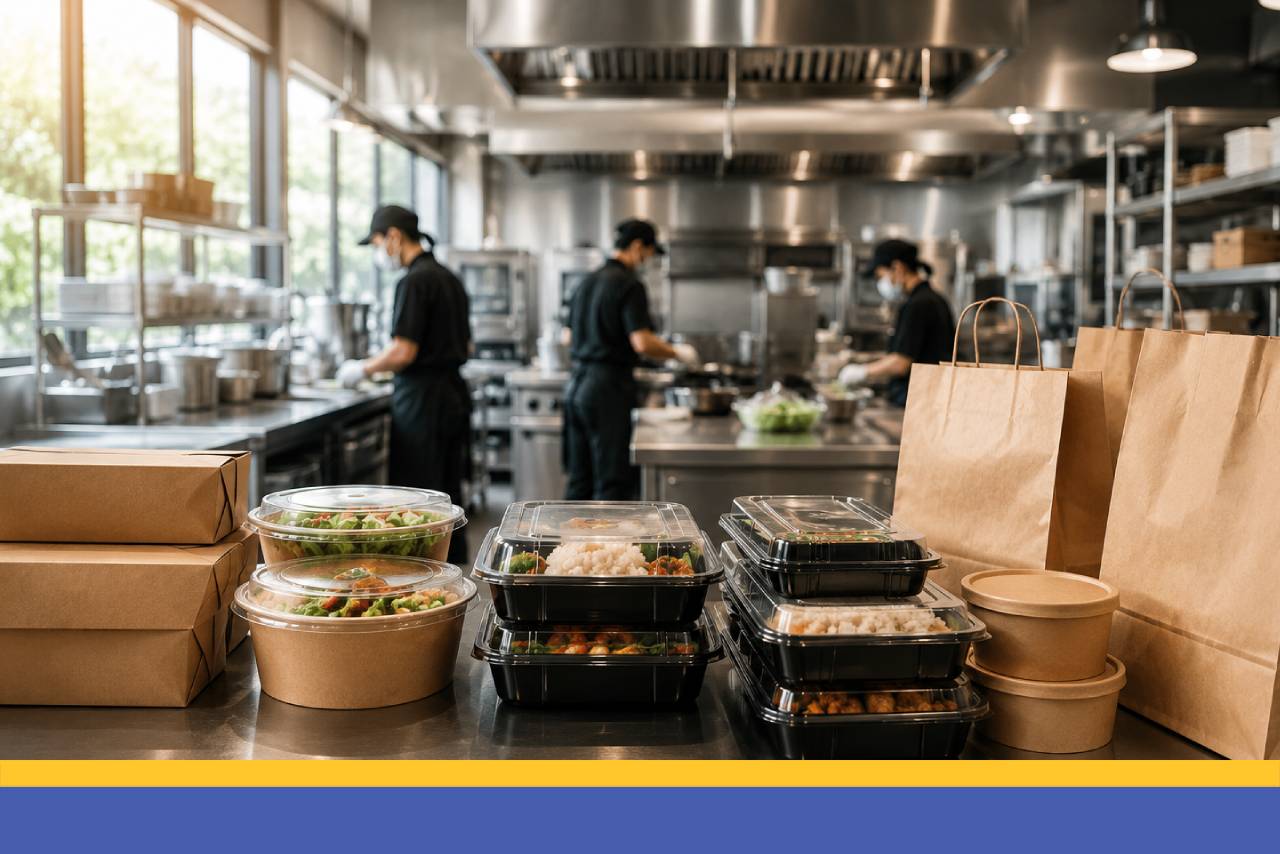
A cloud kitchen is a restaurant business that has only a kitchen. There is no dining room and no counter for walk-in customers. All the food is cooked and sent out mainly through delivery, whether that's apps such as GrabFood, LINE MAN and ShopeeFood, or the restaurant's own ordering channel. Put simply, a cloud kitchen strips out everything to do with the dine-in experience. What's left is the essential part: a kitchen that makes great food and gets it to customers fast.
Many of these kitchens sit where rent is cheaper than on a main road, such as a side street that riders can reach easily. Some are in shared kitchen spaces, where a provider rents out kitchen units by the month. Either way, start-up costs are much lower than for a restaurant with a dining room.
How is a cloud kitchen different from a regular restaurant?
Here's a side-by-side comparison.
Regular restaurant | Cloud kitchen | |
|---|---|---|
Front of house | Seating and décor | No customer seating; kitchen space only |
Main sales channel | Walk-in customers, plus some delivery | Almost entirely delivery |
Rent and fit-out | High, to draw customers in | Lower, with no ambience to create |
Front-of-house staff | Waiting and host staff needed | Not needed; focus on kitchen and packing staff |
Brands per site | Usually 1 brand per restaurant | Several brands from one kitchen (virtual brands) |
What drives success | Location, ambience, in-person service | Cooking speed, food quality on arrival, handling orders from several platforms |
The difference isn't only "seats or no seats". It changes the whole cost structure and what decides whether the business succeeds.
Dark kitchen, ghost kitchen, cloud kitchen: is there a difference?
People new to the idea often ask this. The answer: all three mostly mean the same thing, a kitchen with no dining room that sells mainly through delivery. The terms just differ by market or provider.
- Cloud kitchen usually stresses a central kitchen run through digital, cloud-based systems for taking orders and reporting sales.
- Dark kitchen is popular in Europe and parts of Asia. The kitchen is "dark" to customers, who never see a shopfront.
- Ghost kitchen is common in the US and means much the same: a kitchen with no physical presence customers can visit.
In the Thai market, the three are used interchangeably. What matters more is understanding the business model, not the name.
The benefits of a cloud kitchen
Lower start-up costs than a dining room
With no seating to build, no décor to impress and no waiters or front cashiers to hire, the large sum you'd have spent on all that can go into better ingredients or marketing on delivery platforms instead.
Several brands from one kitchen (virtual brands)
This is what makes a cloud kitchen more interesting than "a restaurant without a dining room". One kitchen can produce food for several brands at once. For example, it might run a home-style rice box brand, a noodle brand and a dessert brand, each with its own storefront on delivery apps. Customers have no idea all three come from the same kitchen. You get the most out of your kitchen space, equipment and staff, instead of opening a new kitchen every time you want to try a new brand.
For restaurants that already have a dining room and want more income, using the existing kitchen to launch a second or third virtual brand is a shortcut that needs no new kitchen at all.
Test the market fast and adapt quickly
You're not tied to a long lease or a fit-out that's hard to change. So a cloud kitchen can change the menu, rebrand, or close a brand that isn't working and open a new one much faster. It suits anyone who wants to test new menu ideas before investing in something bigger.
Things to watch out for before you start
Heavy reliance on delivery platforms, and GP fees
With no walk-in customers, almost all your sales come through delivery apps. Those come with a commission, known in Thailand as the GP (gross profit) fee, which the platform takes from every order. So you need to cost your menu carefully from the start and build the GP into your prices. Don't price the same as you would in a dining room and get hurt later.
Food quality on arrival is harder to control
The dish that leaves your kitchen and the one the customer unpacks can be very different, because it spends tens of minutes on the road. A dish that's delicious hot can turn soggy, mushy or cold by the time it arrives. So a cloud kitchen must always think about menu and packaging together, not just how the food tastes in the kitchen.
Orders from several apps at once are easy to mix up or miss
If you sell on GrabFood, LINE MAN and your own ordering channel at the same time, each platform has its own order screen. Your kitchen team has to keep glancing at several screens and several alert sounds at once. At peak times, when orders pour in, the risk of missing an order, making the wrong dish or sending late goes up sharply. Many cloud kitchen owners say this is the biggest daily headache.
Packaging has to be designed for travel
Every dish has to travel, so packaging can't be any old box. Choose materials that don't leak, hold heat for longer and stop the food getting knocked out of shape on a motorbike. Good packaging may cost more than you expect, but it directly decides your customer reviews.
How to start a cloud kitchen: a starter checklist
- Choose the right location or rented kitchen. It doesn't have to be on a main road, but it should be easy for riders to reach and close to your target customers. Some people rent space in a shared central kitchen, which takes a lot of the work out of permits and utilities.
- Design a menu that travels well. Pick dishes whose taste and texture hold up after 20–30 minutes. Avoid dishes that must stay crispy or soups that spill easily.
- Sign up with delivery platforms such as GrabFood, LINE MAN and ShopeeFood. Prepare appealing menu photos and descriptions, because on a delivery app, the photo is your shopfront.
- Set up multi-channel order management from day one. Don't wait until orders pile up to fix the problem. Have a system that brings orders from every platform into one place from the day you open.
- Test your packaging for real. Order your own food for delivery before you launch, and check it still tastes as good as when it left the kitchen.
- Plan ingredient stock accurately. With no walk-in customers to help use up extra stock, over-ordering ingredients can lose you money faster than you think.
Can an existing restaurant open a second brand as a virtual brand?
Yes, and it's a strategy more and more restaurants with a dining room are using. The kitchen you already have can cook for a second brand during off-peak hours, such as quiet afternoons, and sell through delivery for extra income, without more space or a new kitchen.
The key is to keep the menu clearly separate from your original brand so customers don't get confused. You also need a system that keeps each brand's orders clearly apart. Even if it's the same kitchen, track each brand's sales, costs and stock separately, so you know which brand really makes a profit and which needs work or should close.
Who is a cloud kitchen right for?
Who | Good fit? | Why |
|---|---|---|
People starting a food business on a limited budget | Great fit | Lower start-up costs than a dining room, less money tied up |
Existing restaurants wanting more income from their kitchen | Great fit | Use the same kitchen to launch a virtual brand with no new investment |
People testing menu ideas before scaling up | Good fit | Faster to change or close a brand than with a shopfront |
People who want to build a brand through ambience and in-person service | Not a fit | A cloud kitchen has no space for customers to experience |
People not ready to handle orders from several platforms at once | Prepare first | Without the right system, orders get missed easily |
How to manage orders from several platforms without things falling apart
As you can see, success in a cloud kitchen isn't only about taste. It depends on the back-end system that keeps the kitchen running smoothly when orders come in from several places at once.
This is where Qashier helps. It connects directly with GrabFood, so delivery orders flow straight into the same system as the rest of your sales, and you don't have to keep switching between screens. Once an order arrives, it goes to the Kitchen Display System (KDS), which can be split by kitchen station. Your kitchen team sees clearly which brand each order is from, what to cook, and the right queue order by arrival time. That reduces wrong dishes and forgotten orders in the rush.
Qashier's recipe-level stock management also deducts ingredients automatically every time an order comes in, so you always know your real stock in real time. And if you want to run several brands or kitchens in future, multi-outlet management under one account lets you see each brand's sales reports separately, from anywhere, in the cloud. If you'd like Qashier to help set up the back end of your cloud kitchen properly from day one, contact the Qashier team for advice.
Cloud kitchen FAQ
Does a cloud kitchen need different licences from a regular restaurant? In principle, a cloud kitchen still needs the same food business licences as a regular restaurant, such as a food production premises licence and registration with the local authority. Check the latest requirements with the relevant local authority where your kitchen is before you start.
How much does it cost to open a cloud kitchen? It depends on kitchen size, the equipment you need and how many brands you launch at once. Overall, it's usually less than a restaurant with a dining room, because you don't pay for décor or seating. Cost out every item carefully before you begin.
With no shopfront, how do you get people to know you? Cloud kitchen marketing is mostly online: promotions on delivery apps, appetising food photos, replying to reviews regularly, and social media to build brand awareness. Photos and reviews are all customers have to go on before they order.
How many brands should one kitchen run? There's no fixed number. It depends on your kitchen's capacity and staff. Beginners should try 1–2 brands first, make sure they can handle orders and control quality, then add more once the back end is ready.
Is a cloud kitchen riskier than a restaurant with a dining room? The risks are different. A dining room carries high fixed costs, and a wrong location is hard to fix. A cloud kitchen relies heavily on delivery platforms and faces price competition on the apps. Both can be managed with careful cost planning and a solid back end from the start.
Do I need a POS if there's no counter to take payment? Yes. Even without front-of-house payments, a cloud kitchen still has to manage orders from several platforms, deduct ingredient stock and see sales by brand. A cloud-based POS handles this back-end work far better than writing things down or juggling separate apps.
In summary: a cloud kitchen is an opportunity that comes with homework
- A cloud kitchen has no dining room and sells mainly through delivery. Start-up costs are lower than a regular restaurant, and one kitchen can run several brands.
- The big benefits: you can test the market fast, adapt quickly, and existing restaurants can grow through virtual brands.
- The things to watch: reliance on delivery platforms and GP fees, food quality on arrival, and handling orders from several apps at once.
- Before you start, set up multi-channel order management and design a menu and packaging that travel well from day one.
- Qashier brings GrabFood orders into one system, with a KDS split by kitchen station and real-time ingredient stock, so your cloud kitchen runs properly.
Run your shop better with Qashier, starting today
If you'd like Qashier to help run your restaurant, get in touch. We can help with a restaurant POS or a POS for shops, and support from our team 7 days a week.
Find out more on LINE Official @qashier.th or call 02 544 0267.