
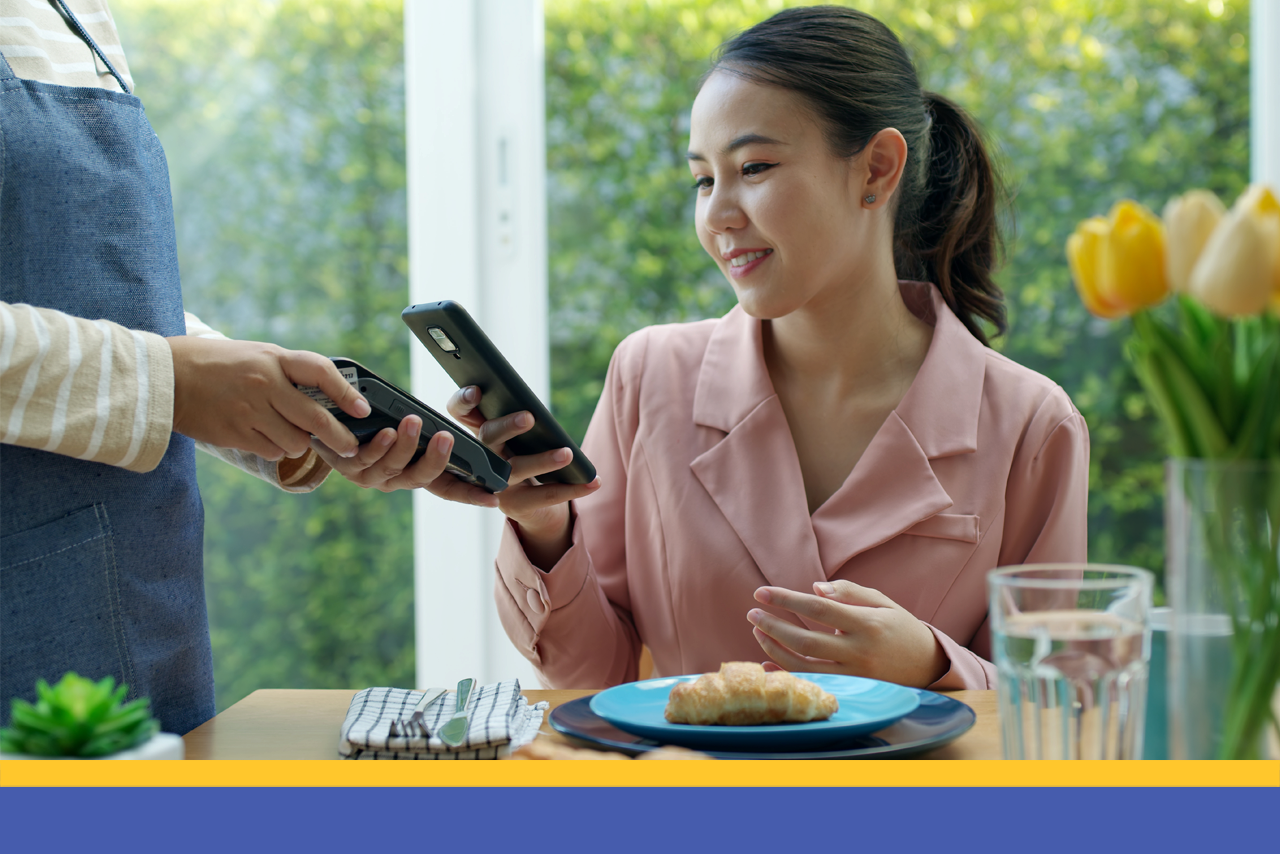
Think about it for a moment. When did you last leave home without your wallet and not feel worried at all? Many people can't even remember the last time they carried a wallet full of cash, because one phone lets you pay almost anywhere.
This isn't just a personal feeling. Shop owners across Thailand are likely seeing the same thing. Customers ask for a QR code more often, phones come out before wallets, and the shop next door has a scan-to-pay sign by the door. So here's the question: if your shop still assumes "most customers pay cash", you may be missing a change happening right in front of you. This article looks at how Thai payment habits are changing, why shops that are slow to adapt risk losing customers, and how to get your shop ready for a cashless society in 2026.
From wallet to phone: how Thai payment habits have changed
Think back ten years. Everyday shopping meant a thick wallet full of notes and coins, checking you had enough, and stopping at an ATM before you left home. Today that picture is fading.
What we see every day is that PromptPay and QR scan-to-pay have become completely normal for Thai people. Whether it's roadside noodles, coffee at a small café or shopping at a department store, paying by phone is nothing new. Even street stalls and food carts now have a QR code sign so customers can pay their own way.
Interestingly, younger people are taking the trend even further. Many hardly carry cash at all, because one phone does everything: paying, transferring money, booking a ride, ordering food. Sometimes the wallet just holds an ID card and a credit card, not cash as it used to.
The range of payment methods keeps growing too. Alongside PromptPay, several e-wallets have become part of daily life, and contactless credit and debit cards are popular because they're quick and need no PIN. Put simply, one customer may now carry several ways to pay, and they expect your shop to accept all of them.
How far have Thai shops adapted to digital payments?
Shops are adapting to customer behaviour too. The most visible change is that more shops of every size have a QR code for scan-to-pay, from small fresh-market stalls and street vendors to big retailers and department stores. Almost no type of business can refuse digital payments any longer.
Many shops now see accepting several payment methods not as an extra, but as something customers expect from the start. Just as shops once had to show clear prices, they now need clear ways to pay. Almost every new business today sets up PromptPay QR and other methods from opening day, without waiting for customers to ask.
At the same time, quite a few shops still rely mainly on cash. It may be habit, worry about set-up costs, or the thought that "my regulars pay cash anyway". That thinking risks leaving a shop behind without it noticing.
Why cash-only shops risk losing sales
Sticking to cash alone when customer behaviour has already changed can hurt a shop more than you'd expect. Here's what happens in real shops.
Customers without enough cash may change their minds. Picture a customer who walks in and picks what they want, only to find at the counter that they have no cash, or not enough. If the shop has no other option, many will put the items down and walk out. That wastes everyone's time. Worse, the shop loses the sale there and then, and the customer may never come back.
Your shop looks dated next to competitors. When the shop next door has a QR code and a card terminal ready, but you still have to tell customers "cash only, sorry", their impression can quickly flip from "nice shop" to "hassle". That's especially true for younger customers who don't carry cash in the first place.
You miss out on tourists and passing trade. Shops in areas with tourists or passers-by face an even bigger risk if they only take cash. These customers usually don't carry much cash and expect convenient ways to pay.
Put simply, every time a shop refuses digital payment, it quietly closes the door on some customers, even though they may be ready to pay right now if they could use the method they prefer.
The challenges of accepting many payment methods
Many owners understand they need to accept more payment methods. But in practice it can be a hassle, especially without a central system.
End-of-day reconciliation gets harder. When you take cash, cards, PromptPay and other transfers, each method leaves a different kind of proof. You may need to open your banking app and check transfers one by one, compare them with card slips, then count the cash separately. Getting the numbers to match each day takes a long time, and the more orders you have, the higher the risk of mistakes.
You need several devices if your POS doesn't cover everything. Shops with an old cash register, or a POS that doesn't support every payment method, often have to add a separate card machine, a separate QR scanner, and sometimes another phone just to check transfer slips. The counter fills up with devices, staff keep switching between them, mistakes happen when the shop is busy, and it looks unprofessional to customers.
Sales data is scattered, with no overall view. When payment methods aren't linked directly to your sales system, you often don't know today's total sales right away. You have to add it up yourself at closing time, so decisions on stock or promotions come later than they should.
These challenges are why many shops are looking for one system that brings every payment method together, instead of patching problems one at a time.
Checklist: is your shop ready for a cashless society?
Check whether your shop is ready for the way customers now pay.
- Do you have a PromptPay QR code for customers to scan, placed where they can see it without asking?
- Do you accept credit and debit cards, including contactless cards that more customers now use?
- Can customers who order ahead or pay a deposit pay you through a payment link?
- Are your counter staff comfortable with every payment method, not just in possession of the devices but slow to use them, keeping customers waiting?
- How long does end-of-day reconciliation take? If you still check each method by hand, it's a sign you need a central system.
- How many payment devices are on your counter? If more than one or two work separately, it may be time for a system that puts everything on one device.
- Can you see total sales across every payment method in real time, without adding it up at closing?
If you answered "no" or "not sure" to several of these, it's a clear sign your shop should start updating how it takes payment, before you lose sales to competitors who adapt faster.
Qashier gets your shop ready for every payment, on one device
The challenges above, from juggling several devices to messy reconciliation and losing customers because you can't take their payment, are exactly what Qashier, a cloud-based POS, is built to solve for Thai businesses.
Qashier accepts several payment methods on one device: cash, credit and debit cards (including contactless), PromptPay with a Dynamic QR generated automatically for each order, and Pay-By-Link for orders and deposits taken remotely. With every payment method in one system, sales from every channel are recorded and summarised automatically. You no longer have to reconcile each method separately.
Whether you run a restaurant, café, retail shop or service business, a system that handles how customers pay today isn't only about convenience. It protects your chance of a sale every time a customer walks in. To find out how Qashier can get your shop ready for a cashless society, contact the Qashier team for advice and a demo. Qashier's goal is to help every business, "For every business dream", keep up with change, however fast customer behaviour moves.
FAQ: cashless trends and Thai shops
What does "cashless society" mean? A society where people use less and less cash and pay through digital channels instead, such as PromptPay transfers, QR scans, cards or e-wallets. It doesn't mean cash disappears completely. Cash simply plays a smaller role in daily life as digital channels grow.
Do small shops really need to accept several payment methods? Increasingly, yes. Customers of all ages, not just younger ones, are getting used to paying by phone or card. Small shops that only take cash risk missing sales from customers who don't carry it, especially in areas with passers-by or tourists.
How can a shop with no POS start accepting more payment methods? Start with a PromptPay QR code, the method Thai people know best. Then consider adding others, such as credit and debit cards. If you want things easy from the start, a POS that handles every method on one device saves more hassle than adding devices one by one.
Will accepting several digital payment methods make end-of-day reconciliation harder? If each method works separately with no central system, yes, because you have to check each one's proof of payment separately. With a POS that brings every payment method together, sales from every channel are recorded and summarised automatically, so reconciliation is much quicker and easier.
Which customers use the least cash? Generally, younger people who grew up with smartphones and banking apps carry less cash than others, because transfers and scan-to-pay are part of their daily life. But digital payment is spreading to every age group, not only the young.
If my shop isn't ready to change everything, where should I start? Use the checklist in this article to see which method your customers want most that you don't yet offer. Then add methods one at a time as you're ready. You don't have to change everything at once, but aim for a system that handles every method in one place, for convenience in the long run.
In summary: shops that adapt fast don't miss out
- Thai payment habits keep shifting, from carrying cash to using the phone as the main way to pay.
- PromptPay QR, cards and other digital methods are now something customers expect, not an extra.
- Cash-only shops risk losing sales, both from customers without enough cash and from looking dated next to competitors.
- Accepting many payment methods without a central system makes reconciliation and device management harder.
- A POS like Qashier, which handles every supported payment method on one device, makes it easier to adapt to a cashless society without losing sales from any group of customers.
Run your shop better with Qashier, starting today
If you'd like Qashier to help run your business, get in touch. We can help with POS terminals for restaurants and shops, a capable POS system, and support from our team 7 days a week.
Find out more on LINE Official @qashier.th or call 02 544 0267.