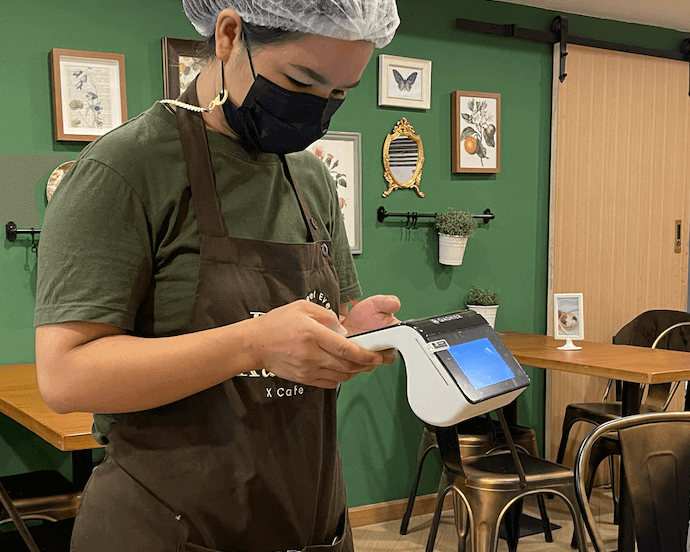
The restaurant business is a fiercely competitive one, and part of the secret of doing well in it is holding onto your customers. To have regulars coming back time after time, your restaurant has to combine good food with looking after people properly. You also have to make it as easy as possible for customers to reach you — and Thailand is a country full of enthusiastic eaters who are always keen to try somewhere new.
If you are running a restaurant that takes nothing but cash, you may be missing out on profit, because Thai society is steadily going cashless. Customers increasingly want to transfer money to a restaurant from their phone by scanning a QR code.
Even food stalls and street vendors now take scan-to-pay. If you run a restaurant or a café that still takes nothing but cash, customers may simply go elsewhere. Rather than tying your hands like that, a POS system will serve your restaurant well over the long run. Today Qashier is going to talk you through choosing a POS system for your restaurant.
Why a POS system is useful to a restaurant
A restaurant POS system is not the same thing as a POS designed for a retail shop or a clothes shop: it can work perfectly well without a barcode scanner or a price-label printer.
Beyond letting your customers pay in other ways, a POS system brings plenty of other benefits — handling customer orders, checking what ingredients you have left, and managing how the staff work. Let's go through what a restaurant POS system does for you.
It streamlines how the restaurant runs
From the moment a customer walks in to the moment they leave, keeping things moving matters enormously to the impression they take away. A restaurant POS system means you never lose track of an order, a free table, or what is happening in the kitchen.
A restaurant POS system that can split a bill when a customer asks makes life easier for the cashier and the customer alike, because nobody has to sit there working the figures out again.
And with food delivery orders growing all the time, having your restaurant POS take the order and send it straight to the kitchen makes the work far easier. You can add the customer's details to the CRM database at the same time.
Use the POS to keep an eye on stock and what is left
Once you are confident customers are coming in to try your food, you have to watch how much stock is left in the kitchen. Ordering too many ingredients, or too few, can both hurt the business. With a restaurant POS system you can avoid both.
The ingredient management built into the POS system warns you when stock is running low enough that you need to reorder, which keeps the business running smoothly and takes away the worry of running out.
Build a base of regulars
A restaurant with no regulars is in trouble. As an owner, you want your restaurant to be supported by the people who keep coming back, because without them it is just another place to eat. So you have to build a genuine relationship between you and your customers.
A POS system for a restaurant or a coffee shop helps you build that base by managing member information (CRM), and lets you send a message or an email about a promotion that suits each individual customer. Using a CRM database alongside promotions built for your regulars is what keeps more of them with you.
Data and reporting in real time
Running a restaurant profitably takes more than instinct and a feel for business — you need accurate, reliable information to build an effective strategy and to make the right decisions. Without it, you can decide wrongly and spend money you had no need to spend.
A restaurant POS system can lift sales and profit by showing you what sells best and what sells worst. That kind of insight makes for better marketing.
Manage your staff better
Beyond running the restaurant, there are your staff to look after. In a small restaurant, mistakes creep in easily if the staff aren't pulling together and taking care of the customers.
With the staff management that comes with the terminal, you can work out commission and wages easily. Sales can be attributed to a particular member of staff, and you can track their hours, so you know who your best performers are and can reward them.
You can also give each member of staff a different role — cashier or shop manager, for instance — and the POS system will lock the features that role has no business using. That way only authorised staff can handle the things that matter, such as refunding a customer.
A restaurant POS system clearly has more going for it than against it. But don't forget that a POS system is a computer like any other, and like any other technology it can freeze, the server can stop responding, or the internet can go down.
If your POS system freezes and you have no backup, you risk losing your sales figures, your profit and loss, or your payroll totals. You then have to key it all in again, and you may lose income along the way. So we would suggest backing up regularly, so your selling never has to stop.
A smart restaurant POS, or a traditional one?
There are as many kinds of restaurant POS system as there are kinds of restaurant. Here we will look at the differences between a traditional POS system and a smart restaurant POS.
Handling data
A traditional POS system usually records data on the device itself, offline, with no connection to anything outside it, so the only way to reach your information is through that one terminal.
A smart POS system, on the other hand, keeps your data in the cloud over the internet. Once it is online, you can reach and manage the information in the POS system whether you are standing in the restaurant or on the other side of the country — any time, from any device.
How the hardware is designed
Most traditional restaurant POS terminals are large and take up a lot of counter space, whereas a smart POS such as Qashier is smaller, because it brings the important parts together in one device, from the two screens to the receipt printer. That saves space on your counter.
What the hardware costs
A traditional POS system usually means a large payment upfront, because there is the terminal and various other hardware to install on site. That means time spent installing it, and maintenance costs when something goes wrong or a terminal has to be replaced. Installing a smart POS system, by contrast, is nothing like as complicated, costs far less upfront, and is usually paid monthly or yearly — which puts it within reach of a small restaurant or café.
What the system can do
Adapting a traditional POS system to give you the features you want can be awkward, because shops generally have to use the hardware and software they are given, which may not suit a restaurant especially well. With a smart POS system you can adapt the software's features to what your restaurant actually needs.
Given those differences, it is clear that a smart POS system has the better of a traditional one. If you own a restaurant, you want a POS system with more going for it than against it, so the business runs smoothly.
The Qashier smart POS system will take the work off your hands and lift your sales along the way. Choosing a POS system for a restaurant can be a difficult thing to get right, but don't worry: you can talk it through with a specialist at Qashier and have your shop set up without any fuss. To order, or for more details, call 02-544-0267 or contact us on Line Official: @qashier.th