
A customer buys something small, taps a card, and you watch the fee come off a sale that barely covered its own costs. The thought arrives on its own: add a card fee, or put a minimum on the till like the shop two doors down.
No Singapore statute specifically prohibits charging a fee for card payment. That is rarely the constraint that matters, because your merchant agreement usually is.
This question is badly served online, and the reason is simple. Most of what is written about card surcharging was written for the American market, where the rules came from an American court settlement and do not travel. Merchants here read it, conclude they are free to surcharge, and skip the one document that actually governs them.
Here is what governs it, what merchants in Singapore do in practice, and four alternatives that do not require anyone's permission.
Three rulebooks, and only one usually matters
They stack. Work down the list, because the binding constraint is almost always at the bottom.
| Rulebook | Does it decide your answer? | What it says |
|---|---|---|
| Singapore law | Not usually the constraint | No statute specifically prohibits a merchant from charging a fee for card payment. This is the layer most people check first, and it is rarely the one that decides the answer. |
| Card network rules | Region specific | Visa and Mastercard set surcharge rules by region, and the permissions differ sharply between markets. Rules written for one region do not travel to another, which is where most confusion begins. |
| Your merchant agreement | Usually the answer | The document you signed with your acquiring bank or payment provider. Local acquirers commonly include terms that forbid adding a visible surcharge at checkout. For most Singapore merchants this is the binding constraint, and it is sitting in a drawer. |
That is the whole answer, and it is why this question generates so much confusion. Merchants search for a law, find nothing prohibiting them, and proceed. The agreement they signed when the terminal arrived is the document with the answer in it, and almost nobody reads it twice.
Why the advice you found online does not apply to you
United States merchants were permitted to surcharge credit cards following a merchant class settlement that took effect on 27 January 2013. Mastercard's own guidance describes that rule change as applying to merchants in the US and US territories. Merchants in other markets are governed by their own regional network rules and local law.
Visa handles surcharging the same way, with rules and disclosure requirements set out region by region. What a Californian retailer may do at checkout tells you nothing about what you may do, and the American caps and notification procedures that turn up in search results are not your rules.
Surcharging is not unheard of in this market. Amazon applied a 0.5 per cent surcharge to Visa credit card purchases on its Singapore site from 15 September 2021 and said so publicly at the time. But a global retailer negotiating directly with a card network is in a different position from a shop with a terminal supplied under a standard agreement, and their example is not a precedent you can rely on.
Before you do anything
Find your merchant agreement and read the section on charges to cardholders. Then put the question to your acquirer or payment provider in writing and keep the reply. If the sums involved are significant to your business, take your own advice. This article is general information and is not legal advice, and no article can tell you what your specific agreement permits.
What Singapore merchants actually do
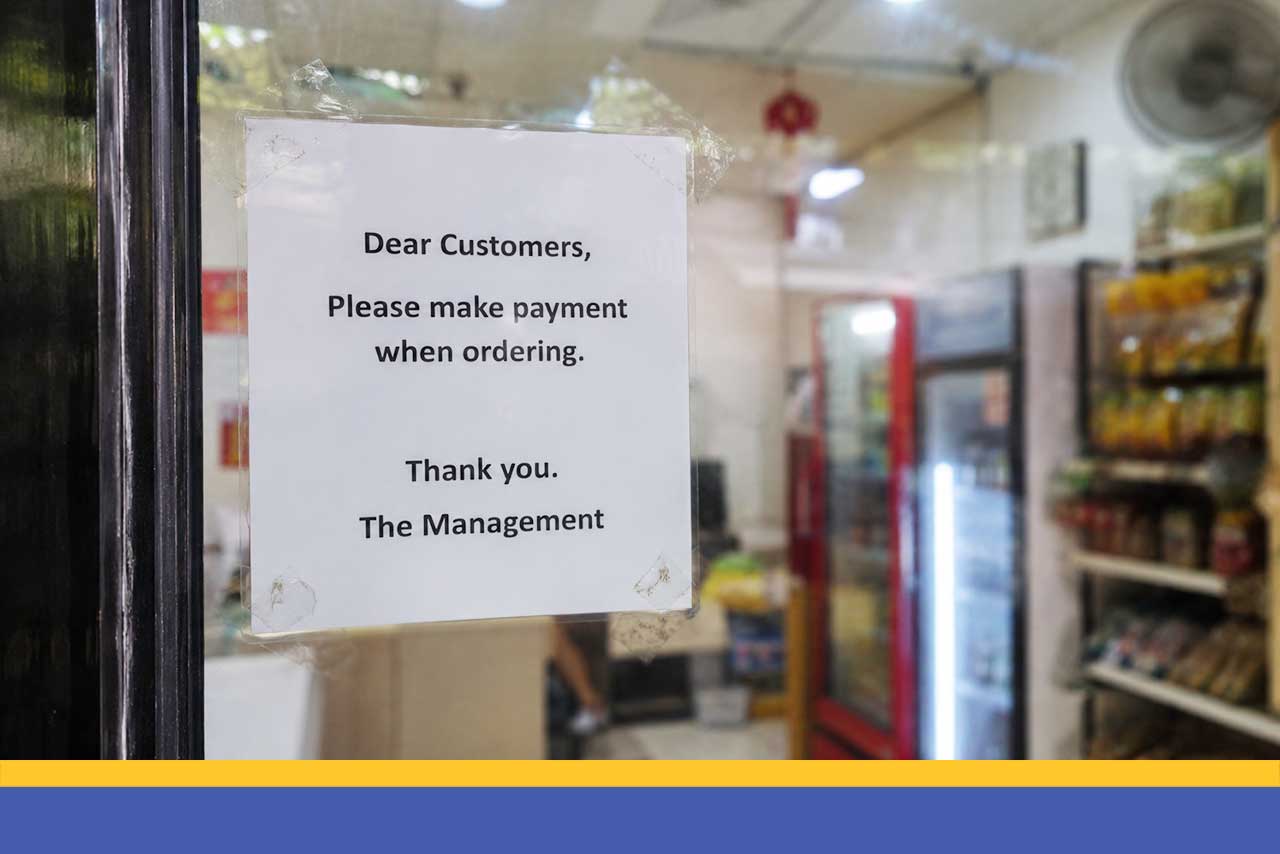
Minimum transaction amounts, mostly. You have seen the signs: a floor below which card payment is not accepted, set at whatever level makes the fee bearable. It is common enough that many merchants assume it is automatically permitted, which is not quite the same thing as it being permitted in their own agreement.
The reason it is so widespread is that it sidesteps the awkward part. Nobody has to add a line to a bill or explain a percentage at the counter. The cost is managed by declining a category of sale rather than by charging for it.
Which is also its weakness. A minimum spend does nothing about your costs on everything above the threshold, and it turns away the customer with an eight dollar basket who would have come back on Friday for forty. Before you set one, work out what it saves you against what it costs you in sales you never see.
Four things to do instead
Ordered from the most common to the most useful. Only the last one makes the cost smaller rather than moving it somewhere else.
Set a minimum transaction amount
The most common approach among small Singapore merchants, and the one your neighbours are probably already using. It avoids adding a line to the bill while steering very small baskets towards other payment methods.
The catch. It does not reduce your costs on anything above the threshold, and a threshold set too high turns paying customers away. Check your merchant agreement before setting one, since acquirer terms address this directly and vary.
Low riskMake a cheaper payment method the obvious one
A prominent QR at the counter and staff who mention it costs you nothing and changes behaviour more than most merchants expect. Domestic rails such as PayNow do not use the card networks, so no interchange applies at all.
The catch. Requires no permission from anybody and touches no agreement. The limit is that it works on the customers who were indifferent, not the ones who want the card.
Low riskAdjust your prices across the board
Payment costs are a cost of trading, like rent and packaging, and most businesses handle them the same way: inside the price. A small, quiet adjustment applied to everyone avoids singling out one payment method and avoids the agreement question entirely.
The catch. It is less precise than a surcharge and it applies to customers who cost you less to serve. For most merchants that imprecision is worth the simplicity.
Low riskReduce the cost instead of passing it on
Audit the charges outside your rate, ask your provider what their own fee is and what would move it, and check whether the pricing model you are on suits your card mix. Each of those points at your supplier rather than your customer.
The catch. It takes more effort than a sign at the till and it is the only option on this list that makes the cost smaller rather than moving it. Earlier articles in this series work through each lever.
No riskThe part that has nothing to do with rules
Even where a surcharge is permitted, it has to be disclosed to the customer before they commit to the purchase. Singapore's Price Transparency Guidelines, issued by the CCCS, treat mandatory fees that are not shown upfront as a potentially unfair practice. A fee that appears only at the moment of payment reads as a trick, whatever the intention behind it, and the reputational cost lands on your business rather than on the card network whose fees prompted it.
Then there is the arithmetic nobody does. The fee on a sale is a fraction of the sale. The margin on a sale that does not happen is nothing. A customer who feels charged for the privilege of paying, or told their basket is too small to bother with, is not a customer who mentions you to a friend.
That is the case for handling payment costs quietly, on the supplier side of the counter, where the customer never encounters them.
Read the agreement first. Then fix the cost, not the customer.
Published 13 August 2026 · Last reviewed 20 August 2026
Rules on charges to cardholders sit in card network regulations that are updated periodically and in merchant agreements that differ between acquirers. This article describes the position as understood at the date above. It is general information, not legal advice, and it cannot tell you what your own agreement permits. Confirm your position with your acquirer or payment provider before you change anything at your checkout.
Sources. Mastercard, Merchant Surcharge Rules, on the rule change that took effect on 27 January 2013 for merchants in the US and US territories. CCCS Guidelines on Price Transparency, in effect from 1 November 2020, on the upfront disclosure of mandatory fees. Amazon.sg Visa credit card surcharge of 0.5 per cent, announced 10 August 2021 and effective 15 September 2021. Checked August 2026.
Work out what it is costing you first
Before you change anything a customer can see, it is worth knowing what card acceptance actually costs your business and which part of that is movable. Ask us and we will talk you through it, whether or not you ever move to Qashier.
Understand the cost before you pass it onFrequently asked questions
Can I charge customers a credit card fee in Singapore?
No Singapore statute specifically prohibits it, but that is rarely the deciding factor. Card network rules are set by region, and local acquiring banks commonly include terms in their standard merchant agreements that forbid adding a visible surcharge at checkout. Read your own agreement and ask your acquirer to confirm in writing before you do anything.
Is a minimum spend for card payments allowed in Singapore?
Minimum transaction amounts are widely used by small merchants here, which is why you see them so often on shopfront signs. Whether yours is permitted depends on the terms you agreed with your acquirer, and those terms address this point directly and differ between providers. Check the agreement rather than assuming that common practice equals permission.
Can I offer a cash discount instead of a card surcharge?
A discount for one payment method and a surcharge on another are close cousins commercially and are often treated differently in merchant agreements and network rules. Because the treatment varies, this is a question for your acquirer and, if the sums involved are significant, your own adviser. Whatever you choose must be disclosed to the customer before they commit to the purchase, in line with the CCCS Guidelines on Price Transparency.
Do the American credit card surcharge rules apply in Singapore?
No. The permission for United States merchants to surcharge credit cards came from a US merchant class settlement that took effect on 27 January 2013, and Mastercard's own guidance describes that rule change as applying to merchants in the US and US territories. Merchants in other markets are governed by their own regional network rules and local law. Most surcharge guidance online is written for the American market and does not describe your position.
What happens if I surcharge in breach of my merchant agreement?
It is a contractual matter between you and your acquirer rather than a criminal one, and the consequences are set out in the agreement you signed. They can include being required to stop, financial penalties, or in serious cases losing your ability to accept certain cards. The practical point is that this is your acquirer's decision to make, so ask them first.
Which payment methods does QashierPay accept in Singapore?
QashierPay accepts Visa, Mastercard and AMEX, along with PayNow, GrabPay, ShopeePay, Atome and Alipay+ and other international e-wallets. In store card payments settle T+1. Qashier holds a Major Payment Institution licence from the Monetary Authority of Singapore.
Do I need to install an app to see what card payments are costing me?
No. QashierHQ runs in a web browser on any device, so your sales, fees and settlement records are available wherever you are. There is nothing to download and nothing to install.
Disclaimer
This article is general information and is not legal, financial or regulatory advice. It does not describe the terms of any particular merchant agreement, and card network rules are set by region and revised from time to time. Merchants should read their own merchant agreement, confirm their position with their acquirer or payment provider in writing, and take independent advice where the amounts involved are material. Qashier is a Major Payment Institution licensed by the Monetary Authority of Singapore.