
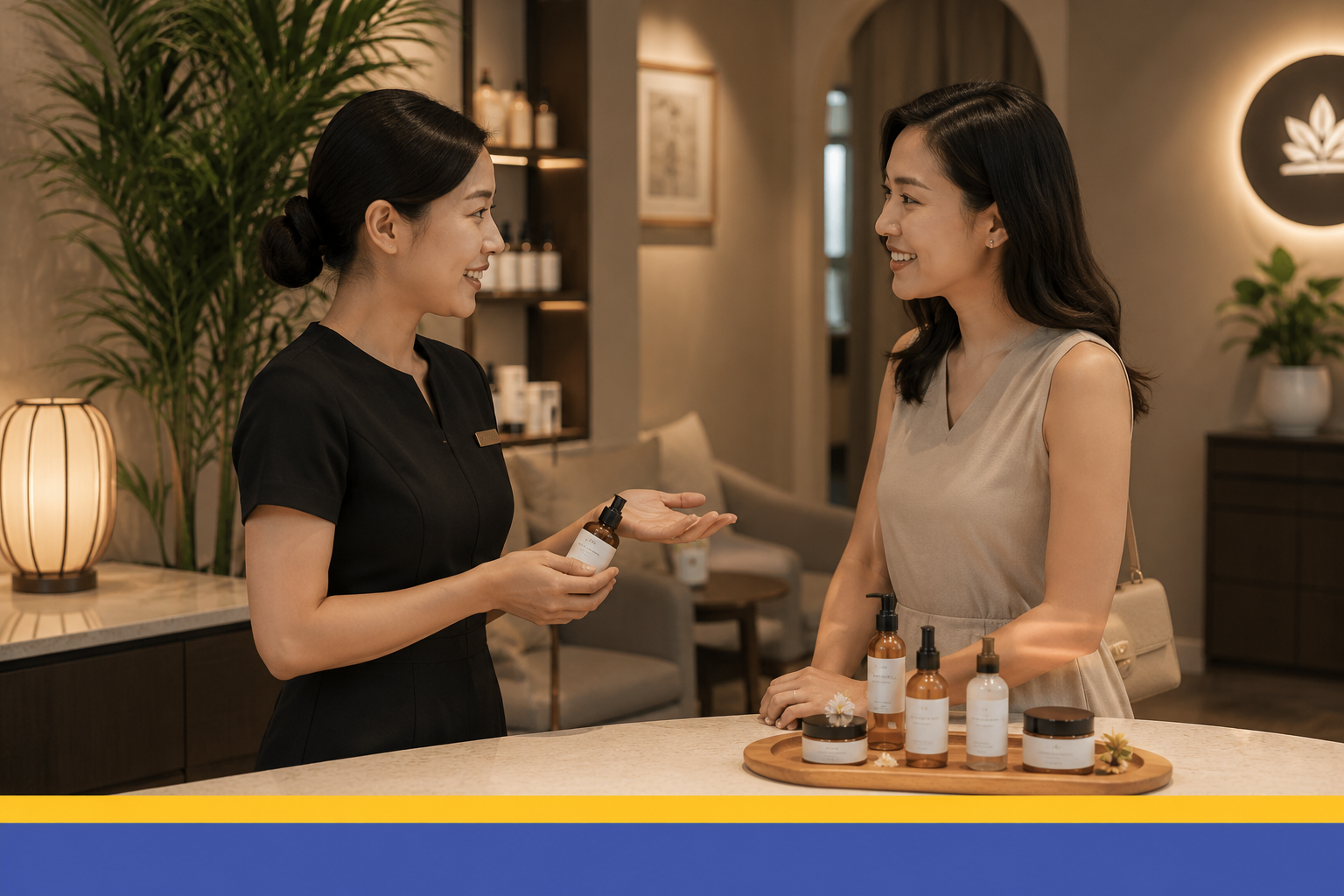
A woman comes in for the first time on a Thursday. She likes it. She pays, you thank her, she leaves happy. That is the last time you will ever see her, and neither of you knows it yet.
You paid for that visit. Maybe it was a boosted post, maybe a commission on a delivery listing, maybe just the rent on a location good enough for her to walk past. Whatever the route, getting her through the door cost you money, and the relationship ended at the receipt. You earned back the price of one meal, or one haircut, or one dress, on an investment meant to buy far more than that.
The second visit is where the economics change. It costs almost nothing to prompt, it usually carries a larger basket, and it decides whether this person becomes a regular or a rounding error. Most businesses spend everything on the first visit and nothing at all on the second.
The second visit is won or lost in about a minute at your counter and the four weeks that follow. Here is what has to happen in each window, and why none of it should mean asking your customer to fill anything out.
The First Visit Costs You Money. The Second One Costs You Almost Nothing.
Acquisition is a purchase. You pay for reach, you pay for position, you pay for the discount that got someone to try you. Retention is a message to someone who already knows where you are and already decided they liked it. One of those has a price per customer. The other has a price per thousand.
That is why the businesses that look effortlessly busy are rarely the ones spending most on advertising. They are the ones converting a higher share of first visits into second visits, so every peso spent on acquisition keeps paying. The gap between a business where one in ten first-timers returns and one where three in ten return is enormous, and it never shows up in the marketing budget. It shows up in the revenue eighteen months later.
What Your Customer Actually Experiences
She orders, you ring it up on QashierPOS, and her receipt carries a QR code. She scans it while she is still at the counter, enters her mobile number, and she is in. No app, no form to fill out, nothing handed back and forth.
That evening she gets a short message thanking her for the visit. A few days later, a prompt asking whether she would leave a review. Three weeks after that, a note about the points sitting in her balance.
She comes back on a Saturday. Her points are recognized at the counter without her presenting anything. She spends more than she did the first time, because she is no longer deciding whether to take a chance on you.
At no point was she asked to download an app, carry a card, or wait while somebody wrote her details in a notebook. None of that required a single manual action from you.
The Minute at Your Counter
Every loyalty program asks for time at exactly the moment you cannot spare it. Forty seconds to collect a name and a mobile number by hand. A minute to explain an app. A paper card to find, stamp and hand over while three people wait behind.
Multiply that by sixty customers a day and you have lost most of an hour of counter time. Which is why it never actually happens. Your staff ask on quiet mornings and stop asking the moment it gets busy, so your program collects customers who came in during your slowest hours and misses almost everyone who came during your best ones.
Qashier Treats moves the sign-up off your counter entirely. The QR code prints on the receipt, the customer scans it in their own time and registers with their mobile number in under a minute. Your staff do nothing. Nothing is added to the queue, nothing depends on somebody remembering a script during a rush, and the customers you capture are a true cross-section of your business rather than a sample of your quiet periods.
The First Twenty-Four Hours
A first visit fades quickly. The customer had a good time, meant to come back, and then a week passed and it stopped being a plan. Nothing went wrong. The memory just got crowded out.
Most businesses have no way to reach that person at all, and the ones that do are working from a list typed into a separate tool, which means the message goes out whenever somebody gets around to it rather than while the visit is still warm.
Qashier Automated Marketing triggers off the transaction itself, so a welcome message reaches a first-time customer the same evening. It is not a sales pitch. It is a short acknowledgment that they were there and that you noticed, which is the cheapest form of goodwill available to any business. You write it once and it goes out to every first-timer from then on.
The First Week, Where Retention Turns Into Acquisition
The best moment to ask for a Google review is a few days after a good visit, while the customer still feels warmly about it and before the details fade. Almost nobody asks then. They ask at the counter, when the customer is in a hurry, or they never ask at all and wonder why the store down the road has four times as many reviews.
The cause is that a review request has to be timed against an individual visit, and most businesses have no record of individual visits. A general request posted to a page produces very little, because it reaches people at random points in their relationship with you.
Qashier Customer Reviews prompts customers to leave a Google review after a visit, at the point they are most likely to say something generous. Those reviews lift your local search visibility, which brings the next stranger through your door without you paying for the introduction. This is where the two halves meet: the work you do to keep one customer is the same work that finds you the next one.
Weeks Two to Four, Where Most First-Timers Quietly Disappear
A first-time customer is not a lapsed regular. A regular who goes quiet has a habit you can restart. A first-timer has nothing yet, only a positive impression with a short shelf life, and the window in which a nudge still works is measured in weeks rather than months.
Nothing in a conventional setup is watching that window. Your POS recorded a sale and moved on. Your notebook does not know when she came. So the most winnable customer in your business is the one nobody is looking at.
Because Qashier Treats holds the visit date and the points balance against the person, Automated Marketing can act inside that window. The message that works here is rarely a discount. It is usually a reminder that something is already waiting for them, which converts better and costs you nothing in margin. You set the timing once, based on how often people normally return to a business like yours, and it runs from then on.
The Second Visit, Where You Either Keep Them or Start Again
A returning customer treated like a stranger has effectively made a first visit twice. The message worked, they came back, and then nothing at the counter acknowledged that anything had changed. That is the moment a good retention effort gets undone.
The cause is that the customer record lives somewhere your staff cannot see during a transaction. Even businesses with a customer list usually keep it somewhere nobody opens while serving.
With Treats running on QashierPOS, the profile is present at the point of sale. Points are recognized without the customer presenting anything. Your staff can see that this person has been in before and what they bought, which turns a transaction into a conversation. None of that requires training or extra steps. It is on the screen they are already using.
Everything Connects, Which Is the Whole Point
Read that sequence again and notice that it is a loop rather than a funnel. The sale creates the member. The member triggers the welcome. The welcome earns the review. The review brings in the next first-time customer. That customer buys, becomes a member, and the whole thing runs again, with the database bigger each time.
None of it works if the pieces are separate. A loyalty program that does not know what was bought cannot time a return message. A contact list typed in by hand cannot tell a first-timer from a regular. A review request posted to everyone at once reaches most people at the wrong moment. The sequence holds together only because the sale and the customer are one record.
The cost argument lands in the same place. Separate tools mean separate subscriptions, separate renewal dates, separate support numbers and separate price rises you did not plan for. Qashier gives you the Essential and Growth plans billed annually, with add-ons available for a small monthly fee on top, all on one bill and one login. You add capability without adding a vendor.
One login. One view. One platform.
Getting Started
QashierPOS, Qashier Treats, Automated Marketing, Customer Reviews and Spotlight are available to businesses across the Philippines now, with the Essential and Growth plans billed annually and add-ons at a small monthly fee. The sequence above starts working from your first transaction, with nothing added to your counter.
Book a free demo and see how many of your first-time customers could be coming back.
Frequently Asked Questions
How do I turn first-time customers into repeat customers?
Capture the customer at the point of sale, follow up while the visit is still recent, and reach them again inside the first month before the impression fades. The sequence matters more than the offer, because a first-time customer responds to being remembered rather than to a discount. It only works when your sales system and your customer records are the same system, so the follow-up can be triggered by the visit itself.
How do I get customers to join a loyalty program without slowing down the line?
Put the sign-up on the receipt rather than at the counter. Qashier Treats prints a QR code that the customer scans in their own time and registers with their mobile number in under a minute, so your staff do nothing and the line keeps moving. Programs that depend on staff collecting details tend to capture customers only during quiet periods.
How soon after a first visit should I follow up with a customer?
A short thank you the same day, a review prompt within the first week, and a reason to return inside the first month. After about four to six weeks a first-time customer's impression of you has usually faded enough that a message reads as marketing rather than as a reminder. Automated triggers handle this timing without anyone tracking it by hand.
Do I or my customers need to download an app?
No. Qashier runs in a web browser, and your customers do not need to install anything to join Qashier Treats. They scan the QR code on their receipt and sign up with their mobile number.
How does Qashier Treats track points at every visit?
Once a customer has registered, points are tracked automatically through QashierPOS each time they buy. Customers can check their balance in the Treats web app and redeem points against future purchases. Your staff do not need to look anything up or record anything manually.
How do I get more Google reviews for my business?
Ask individual customers shortly after a good visit rather than posting a general request. Qashier Customer Reviews prompts customers at that point automatically, which is when people are most willing to write something positive. More reviews improve your visibility in local search, so the effort also brings in new customers.
Can I build repeat business without discounting?
Yes, and discounting is usually the weaker option. A points balance the customer has already earned gives them a reason to return without costing you margin on the next sale, and recognition at the counter costs nothing at all. Discounts work hardest on customers who have gone quiet, not on customers who are still deciding whether to come back.
How much does an all-in-one POS system cost in the Philippines?
Qashier offers the Essential and Growth plans in the Philippines, billed annually. Add-ons are available for a small monthly fee on top of your plan, so you pay for the capability you switch on rather than for a bundle you do not use. Everything appears on one bill and runs from one login.